Example

Next Generation Curves

Beyond SABR, SVI, etc.

Beyond SABR, SVI, etc.

A serious vol fitting framework requires sensible quality-of-fit metrics that are produced and can be used programmatically.

Our infrastructure produces several by default and here we mention two of them, that are shown in all our vol plots (in the title on the right): The reduced chi-square (“chi”), and the average absolute difference between fitted and market implied vols for 5 strikes around ATM, in bps (“avE5”).

The former is a measure of the overall quality of the fit across all (fitted) strikes, relative to the error bars of the implied vols (from the bid-ask spread, say); the latter is a measure of the absolute match between fit and market around ATM.
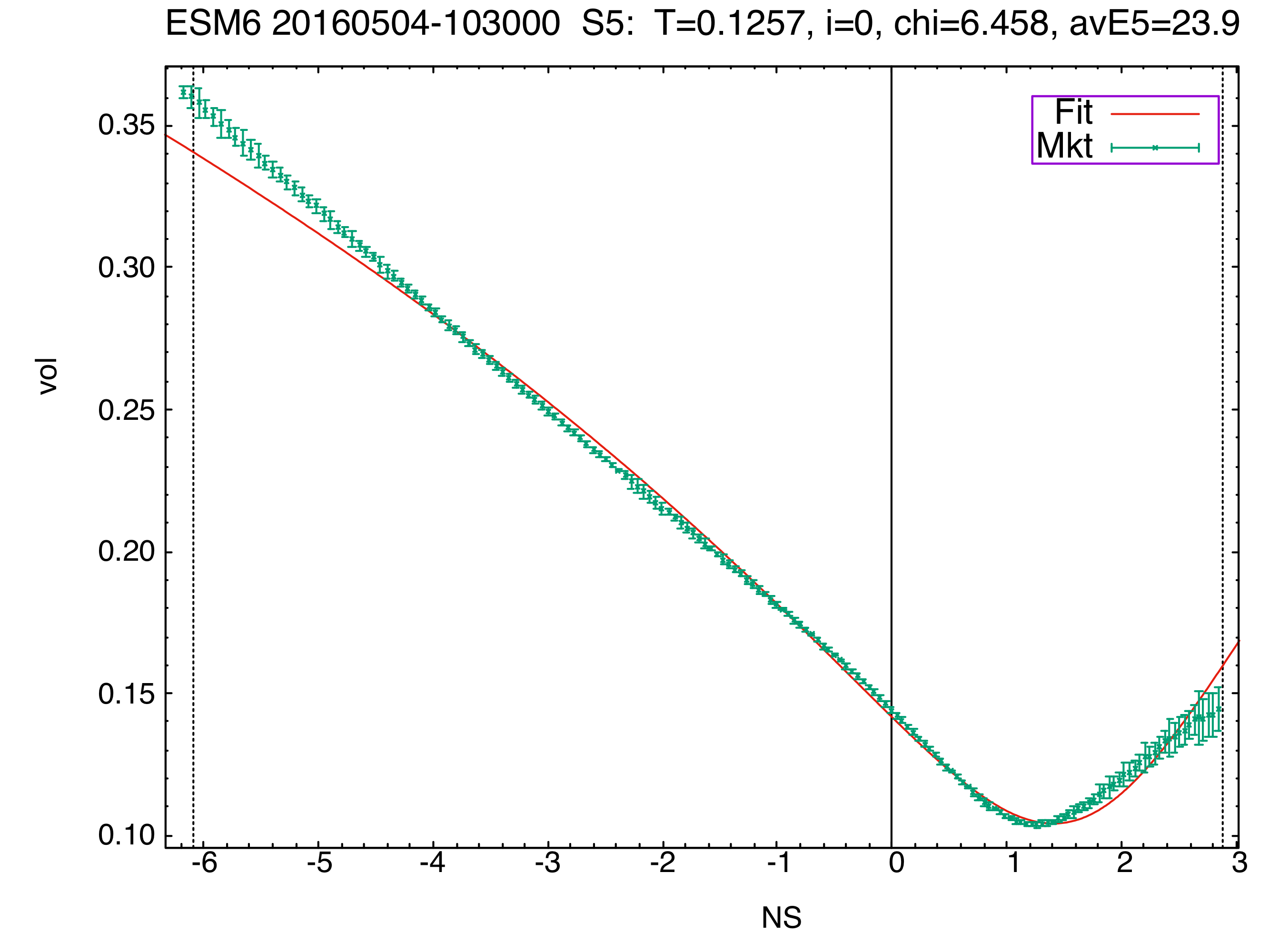
E-mini S&P 500 implied vol surface in normalized strike space fitted with S5 (SVI) — chi=6.458, avE5=24bps, shows bias
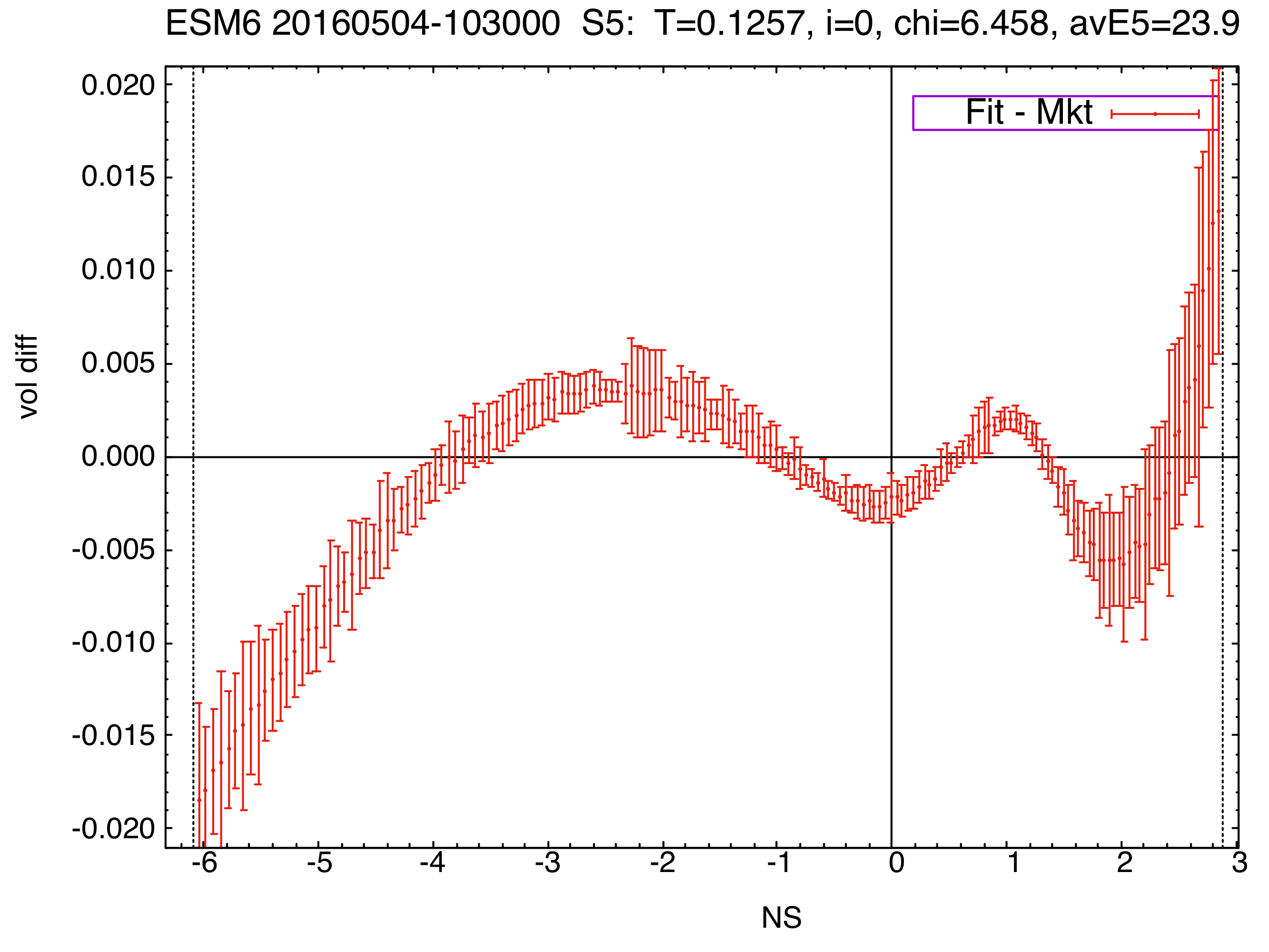
E-mini S&P 500 vol difference plot for S5 (SVI) fit — systematic bias visible across strikes

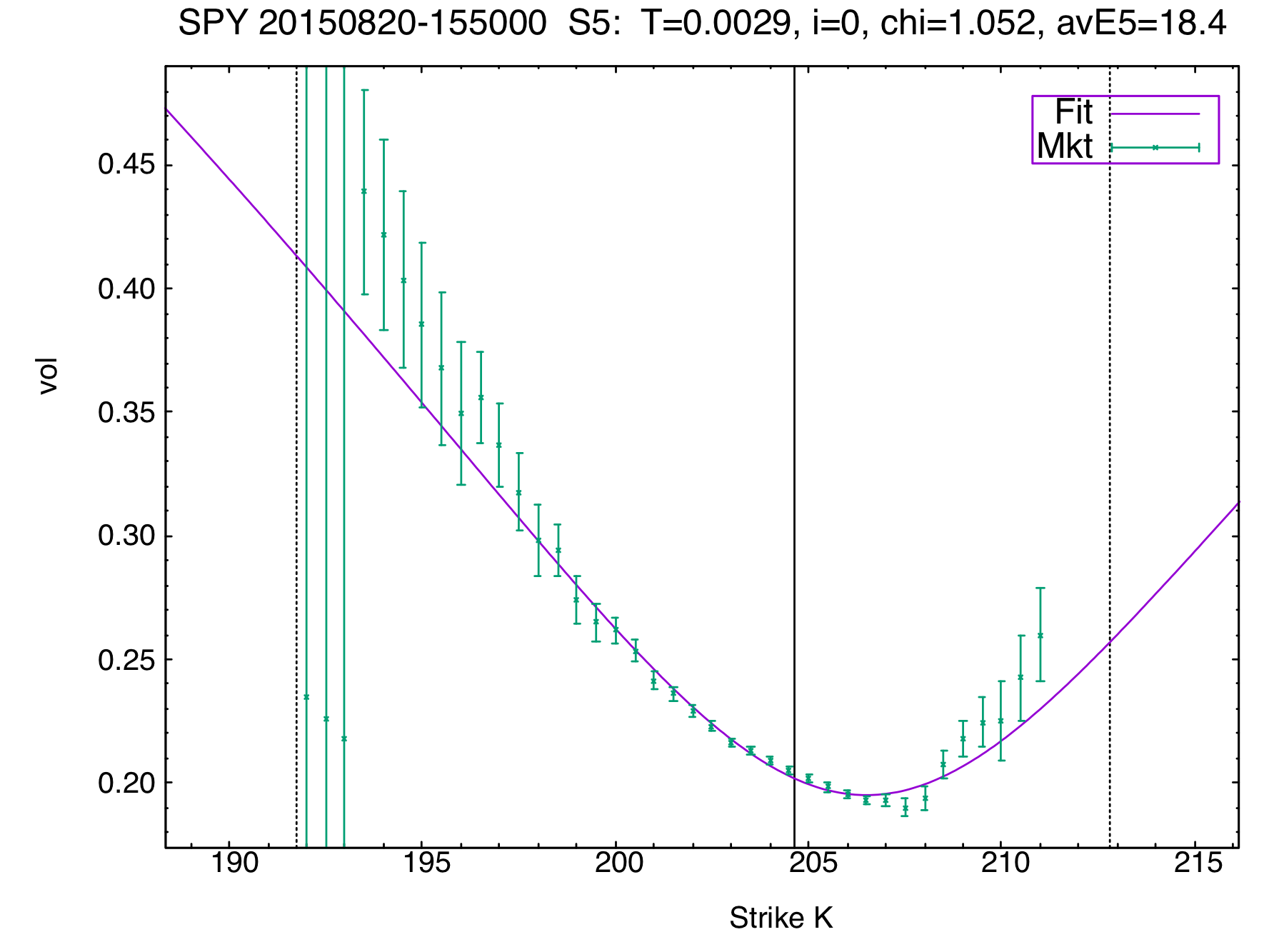
The vol difference plot clearly shows that the SVI (aka S5) parameterization does not manage to capture the vol shape properly; the fit is clearly biased. The same fact is clear from the metrics. The fit has a very bad chi=6.458, and avE5=24bps.

We need something better.
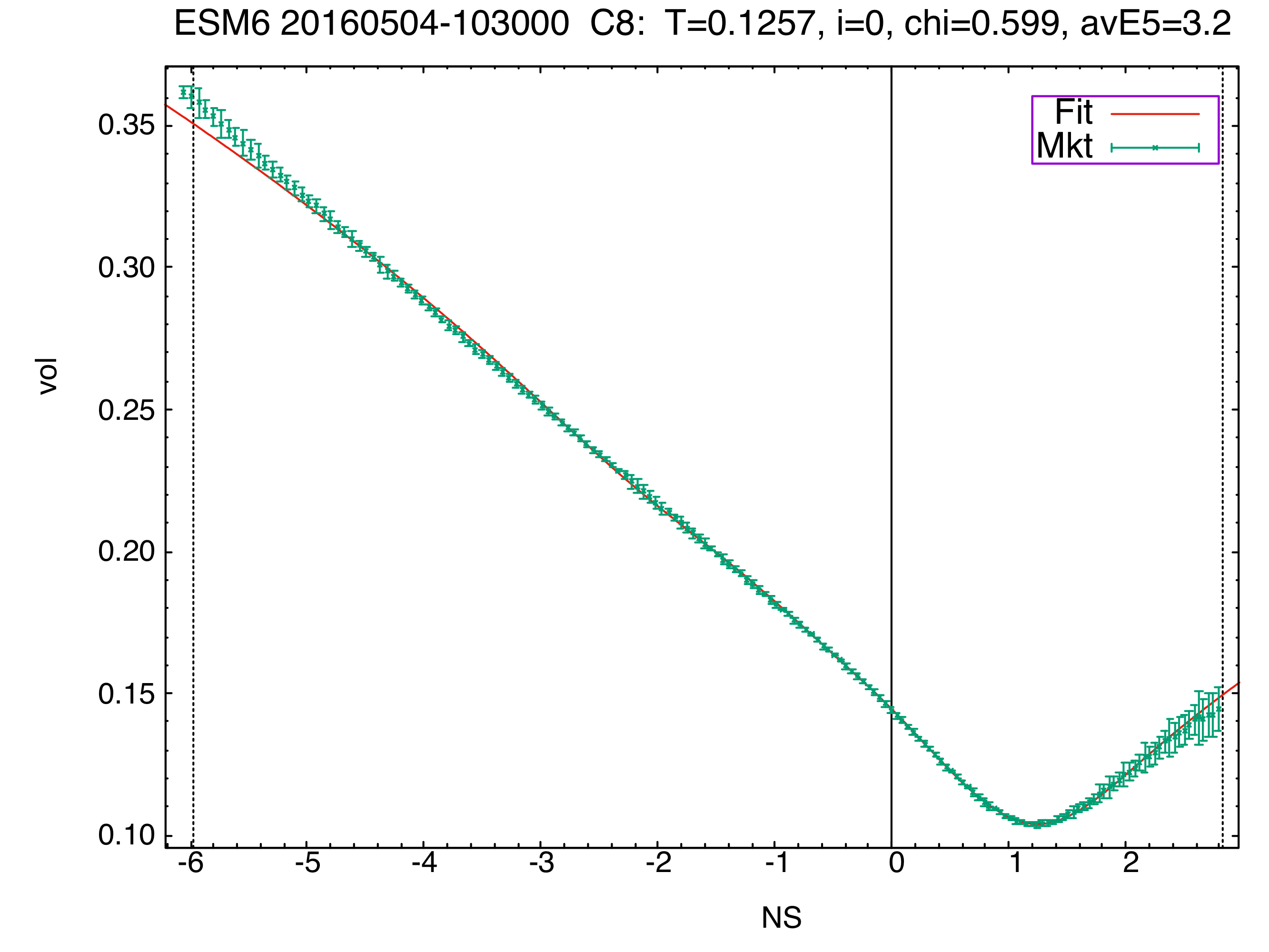
E-mini S&P 500 implied vol surface in normalized strike space fitted with C8 — chi=0.599, 10x better than SVI but some bias remains
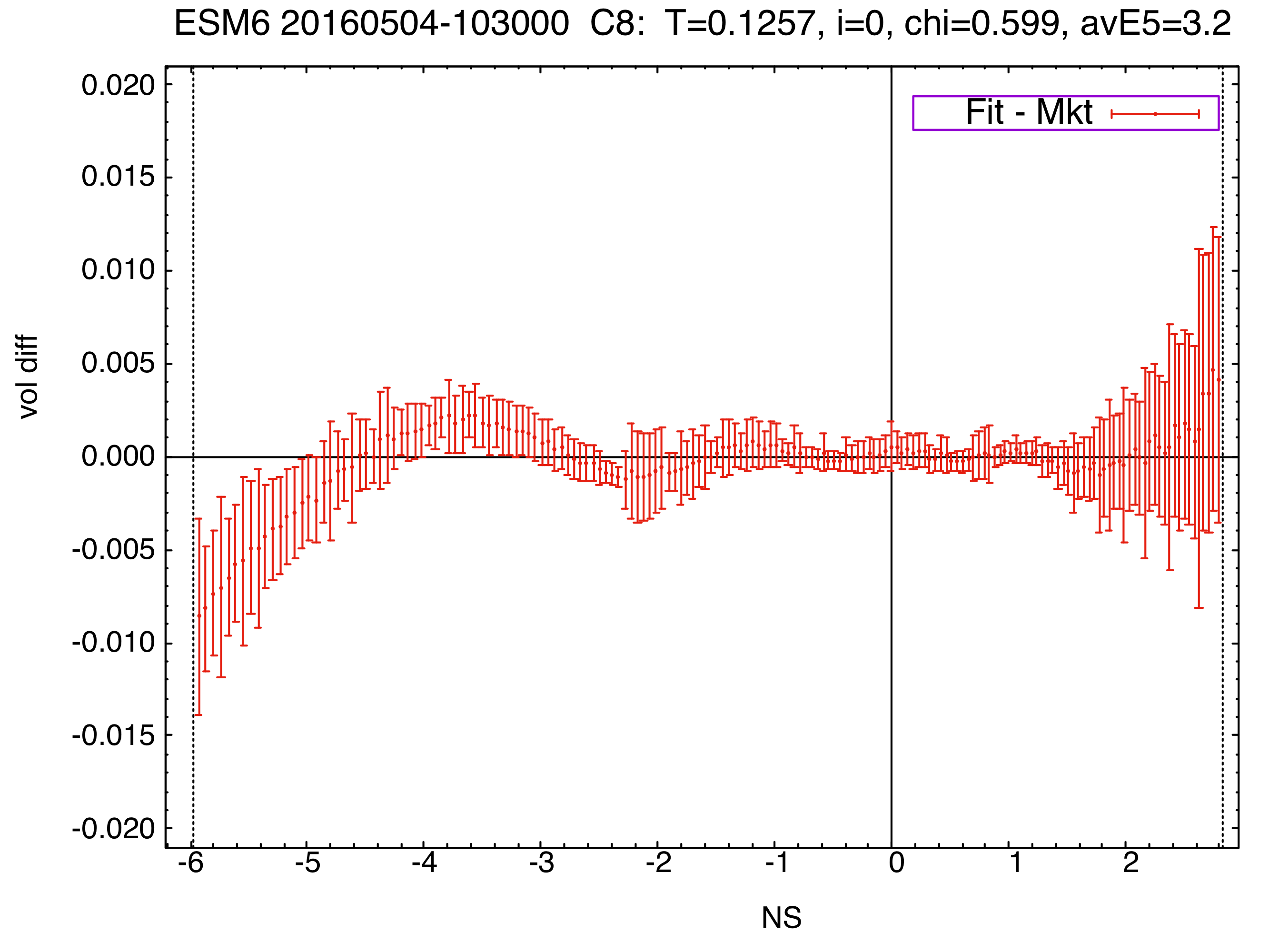
E-mini S&P 500 vol difference plot for C8 fit — less bias than SVI but some remains

Here we use our C8 curve to fit the data. It is clearly much better at capturing the vol shape. Note that chi=0.599, which is a factor of 10 better than the SVI curve; avE5 improved by a factor of 8. But there still is significant bias in the fitted curve.

We can do better.
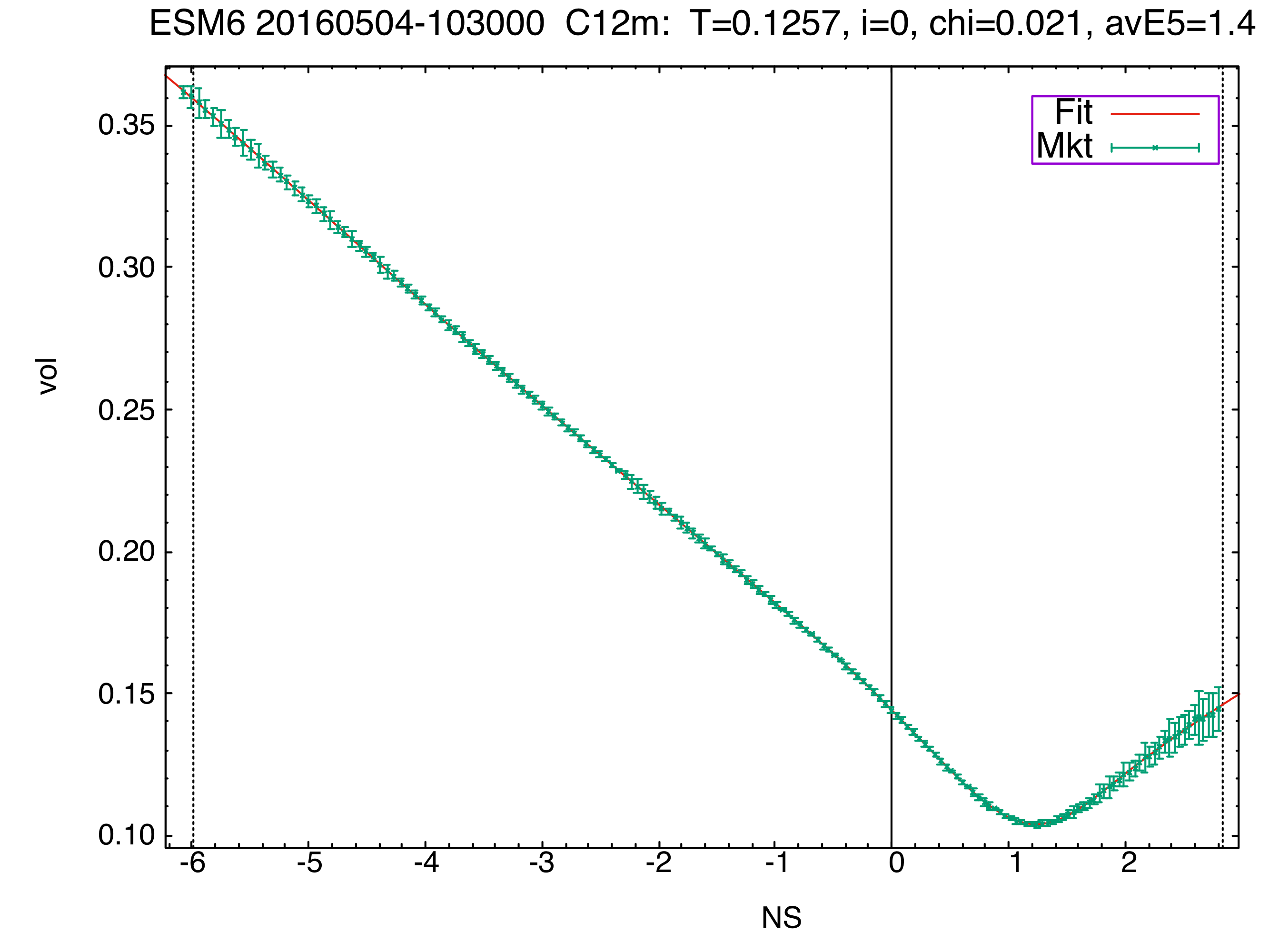
E-mini S&P 500 implied vol surface in normalized strike space fitted with C12m — chi=0.021, over 300x better than SVI, no bias
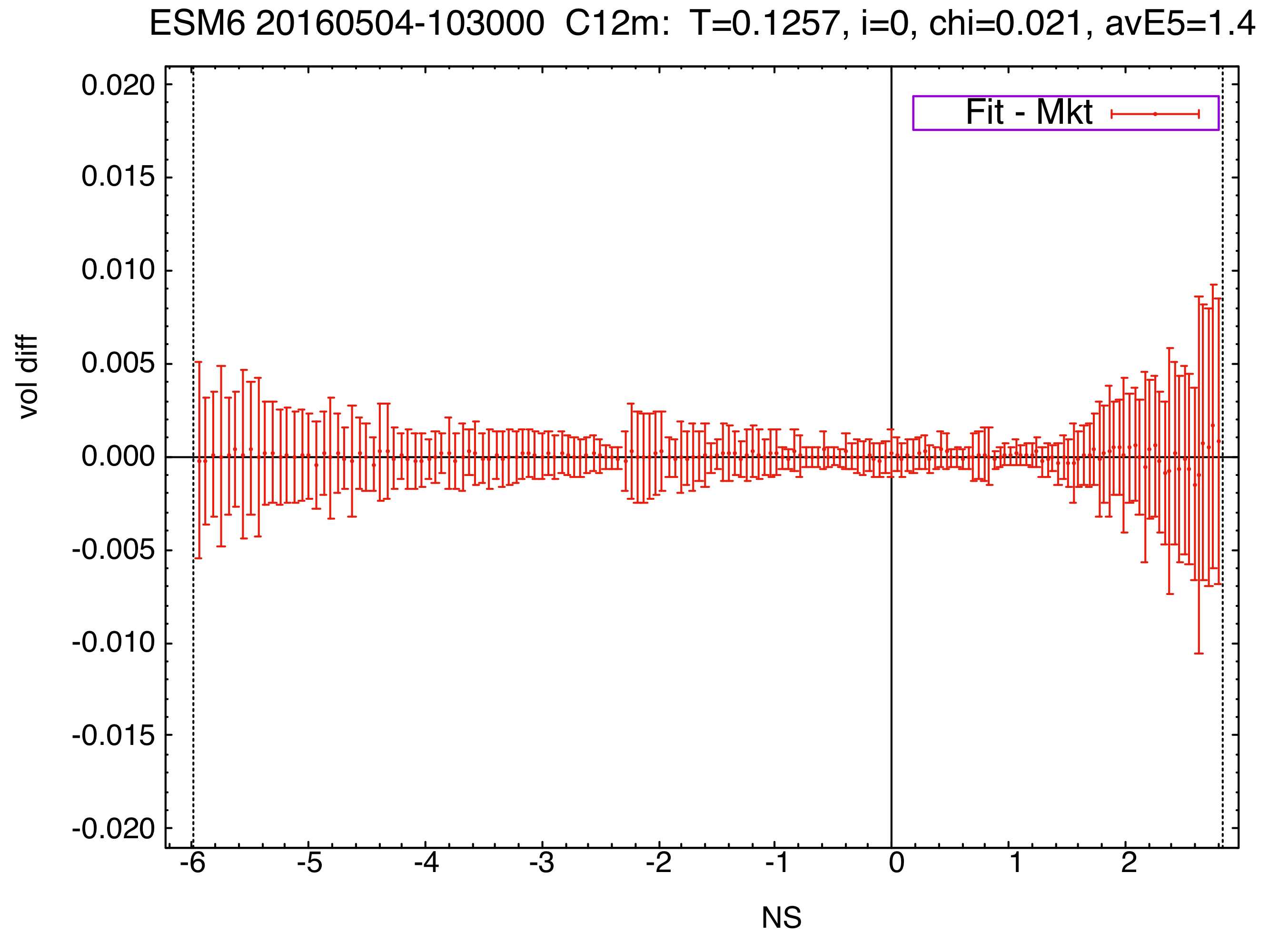
E-mini S&P 500 vol difference plot for C12m fit — no bias across strikes

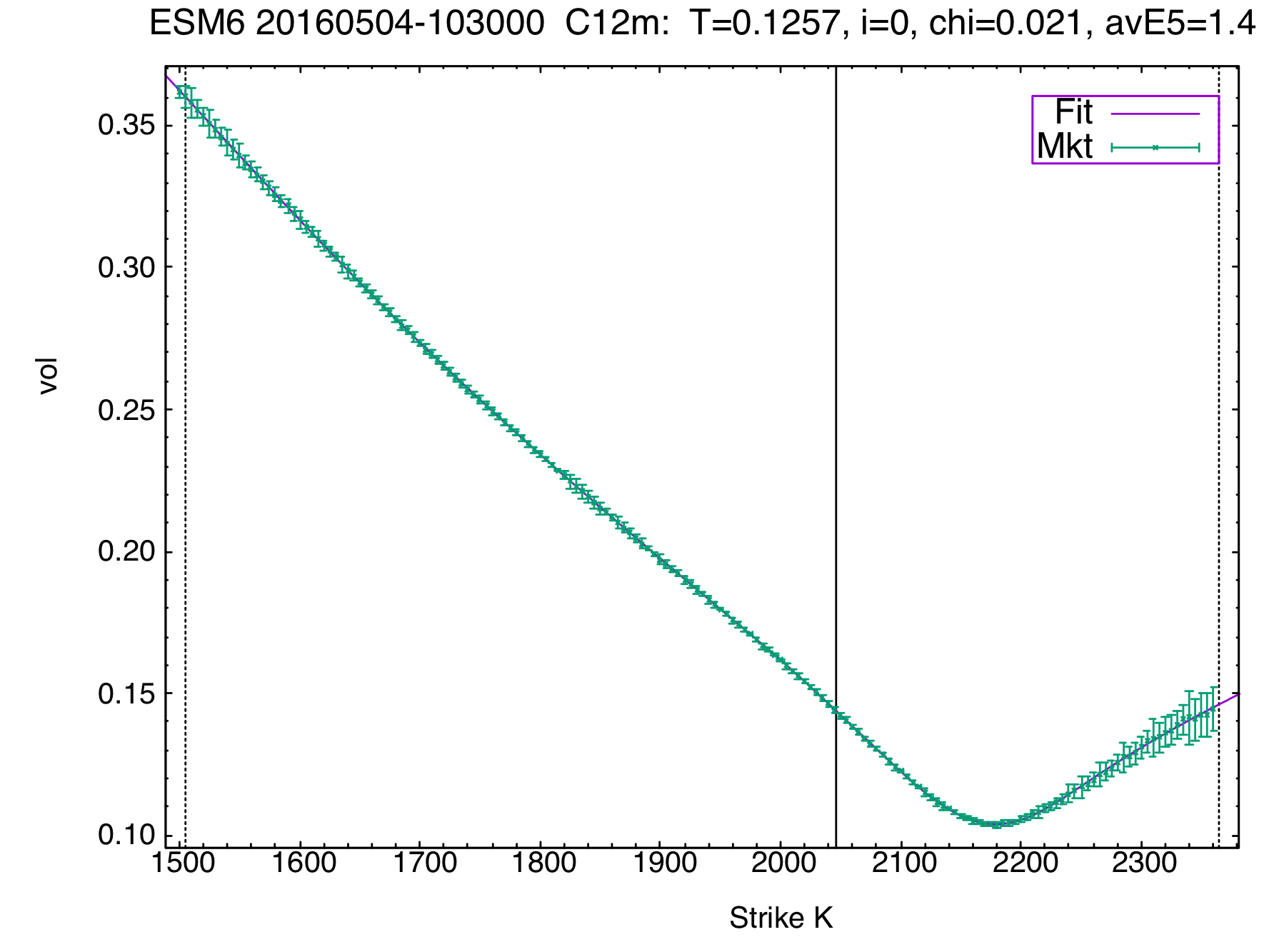
Here we advise to use the C12 curve. Its chi=0.021 is over 300x better than the SVI one. It provides a bias-free fit across all strikes. The vol difference plots looks like the above on all snapshots.

You can trade off this curve and our clients do.

Some more details and comparisons

S5
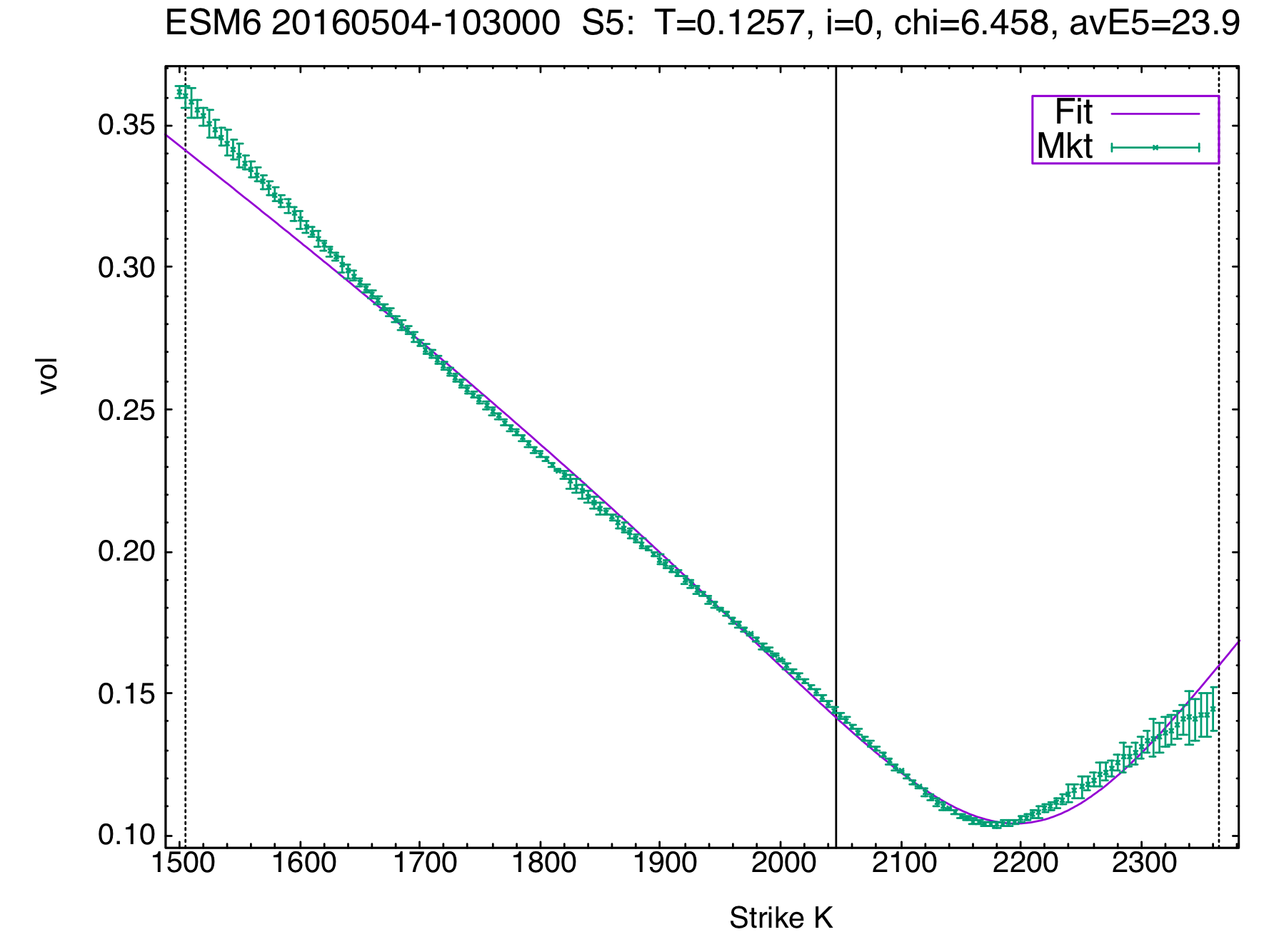
E-mini S&P 500 May 2016 implied vol surface fitted with S5 (SVI) vs strike — shows bias

C12m

E-mini S&P 500 May 2016 implied vol surface fitted with C12m vs strike — no bias

S5

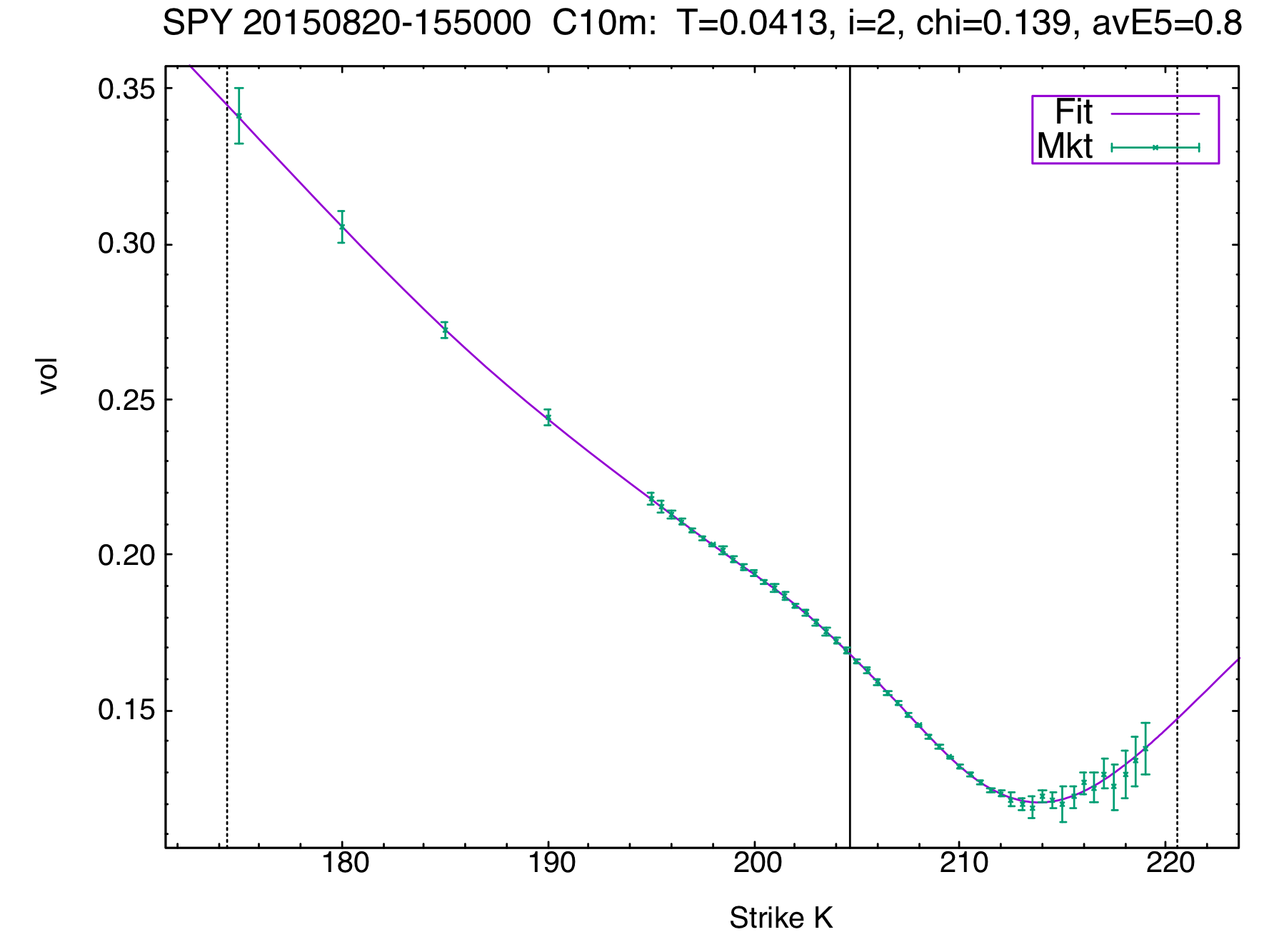
SPY August 2015 implied vol surface fitted with S5 (SVI) vs strike, near-term expiry — shows bias

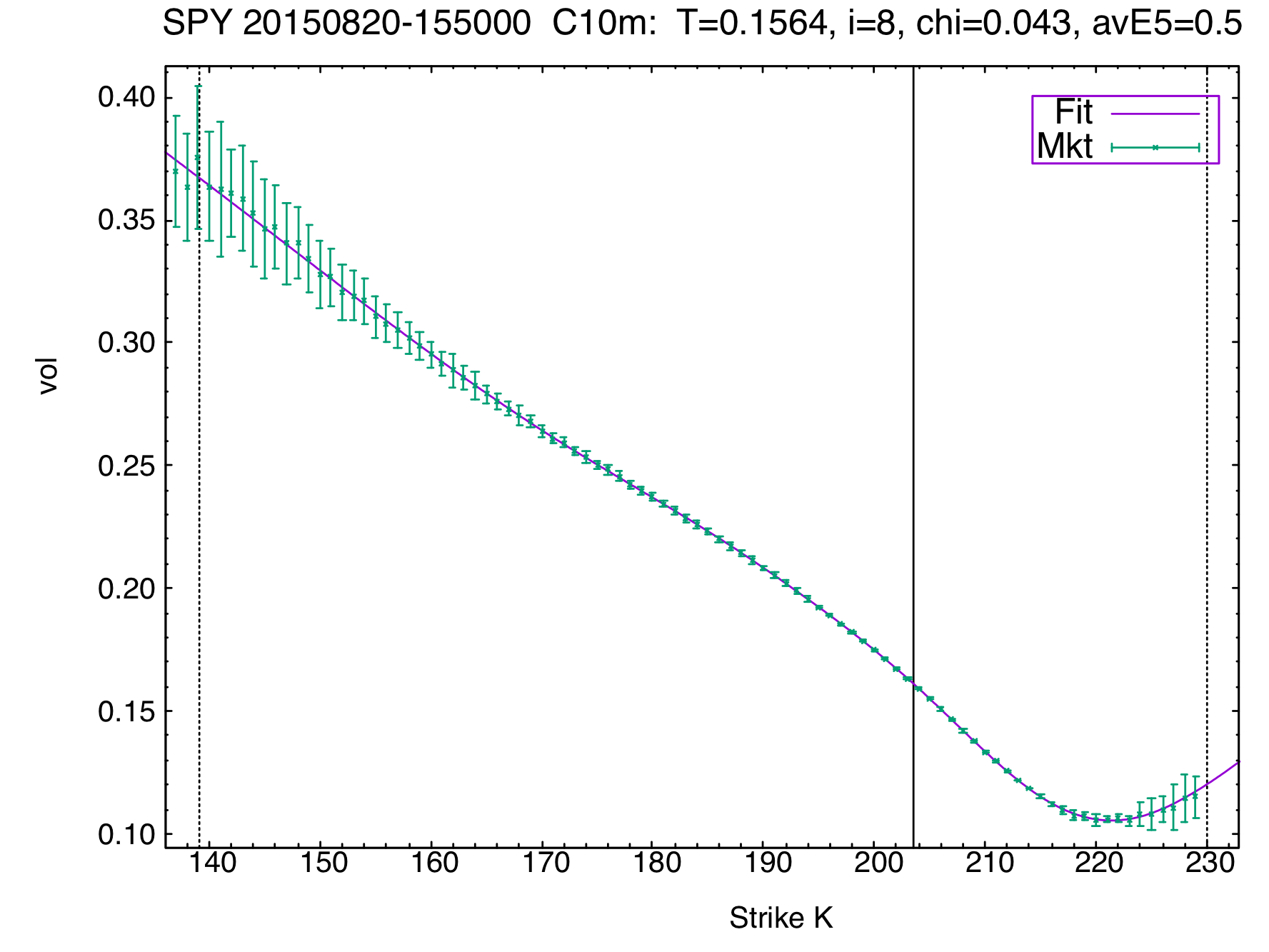
C10m

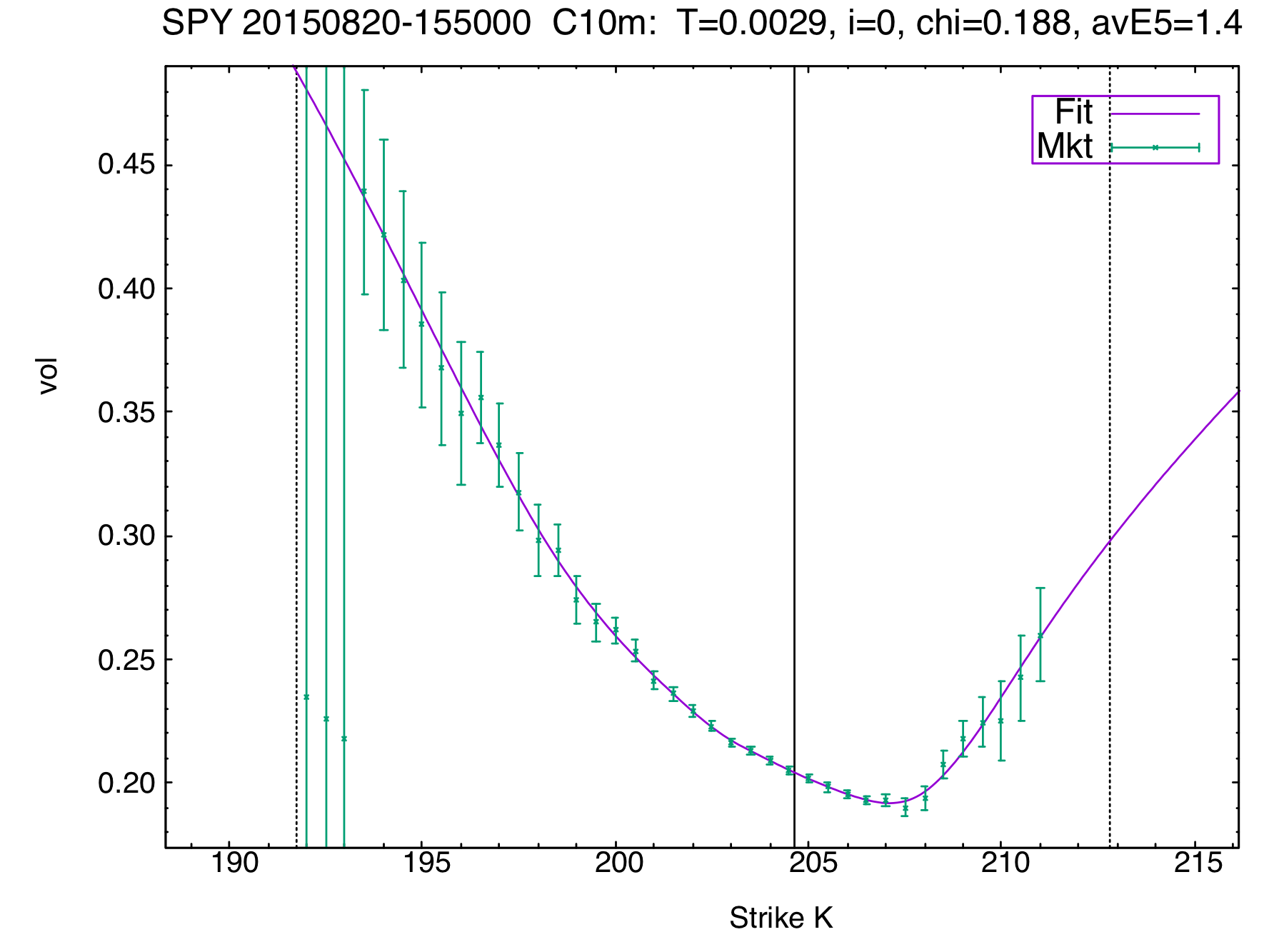
SPY August 2015 implied vol surface fitted with C10m vs strike, near-term expiry — no bias

S5

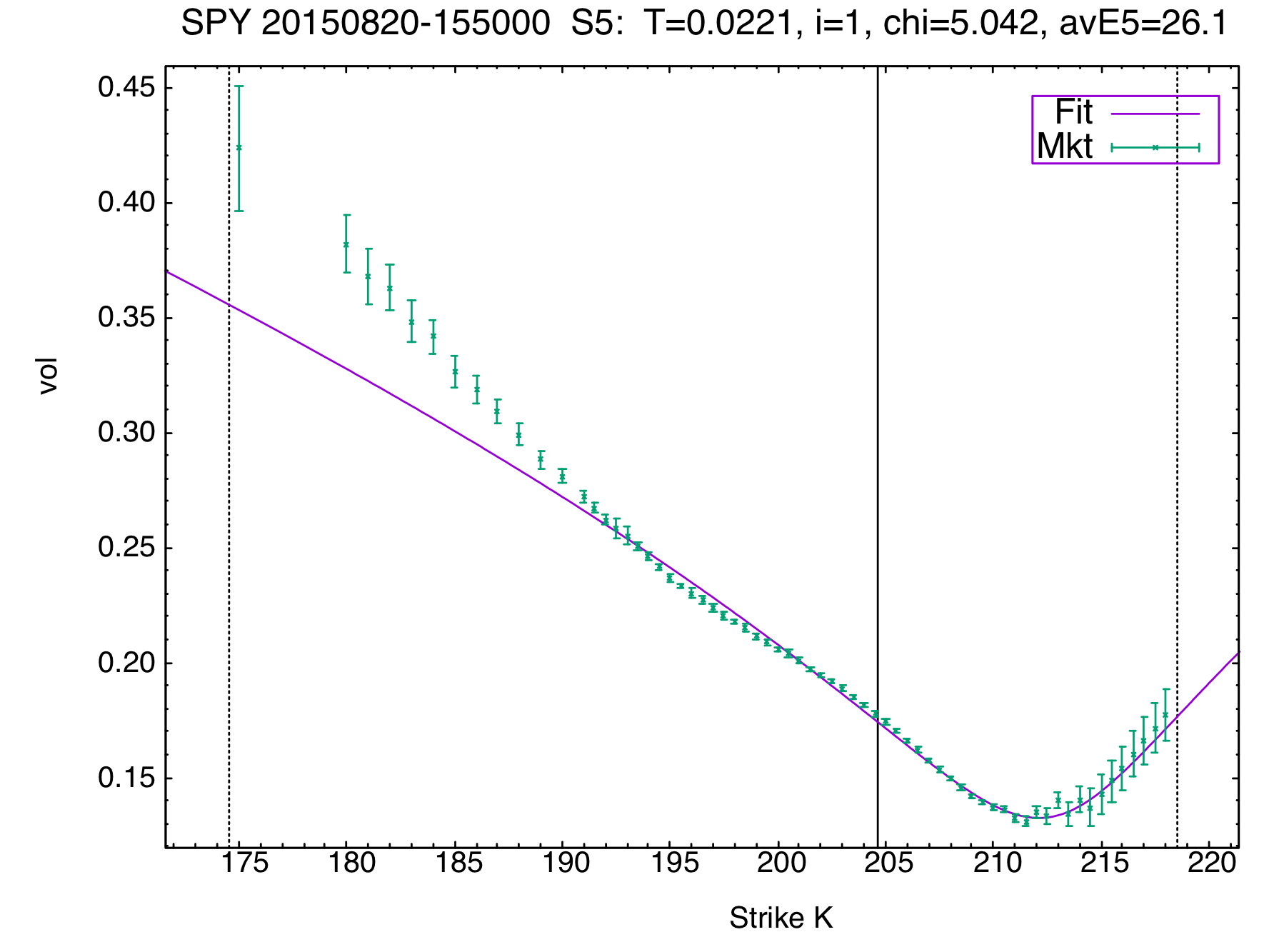
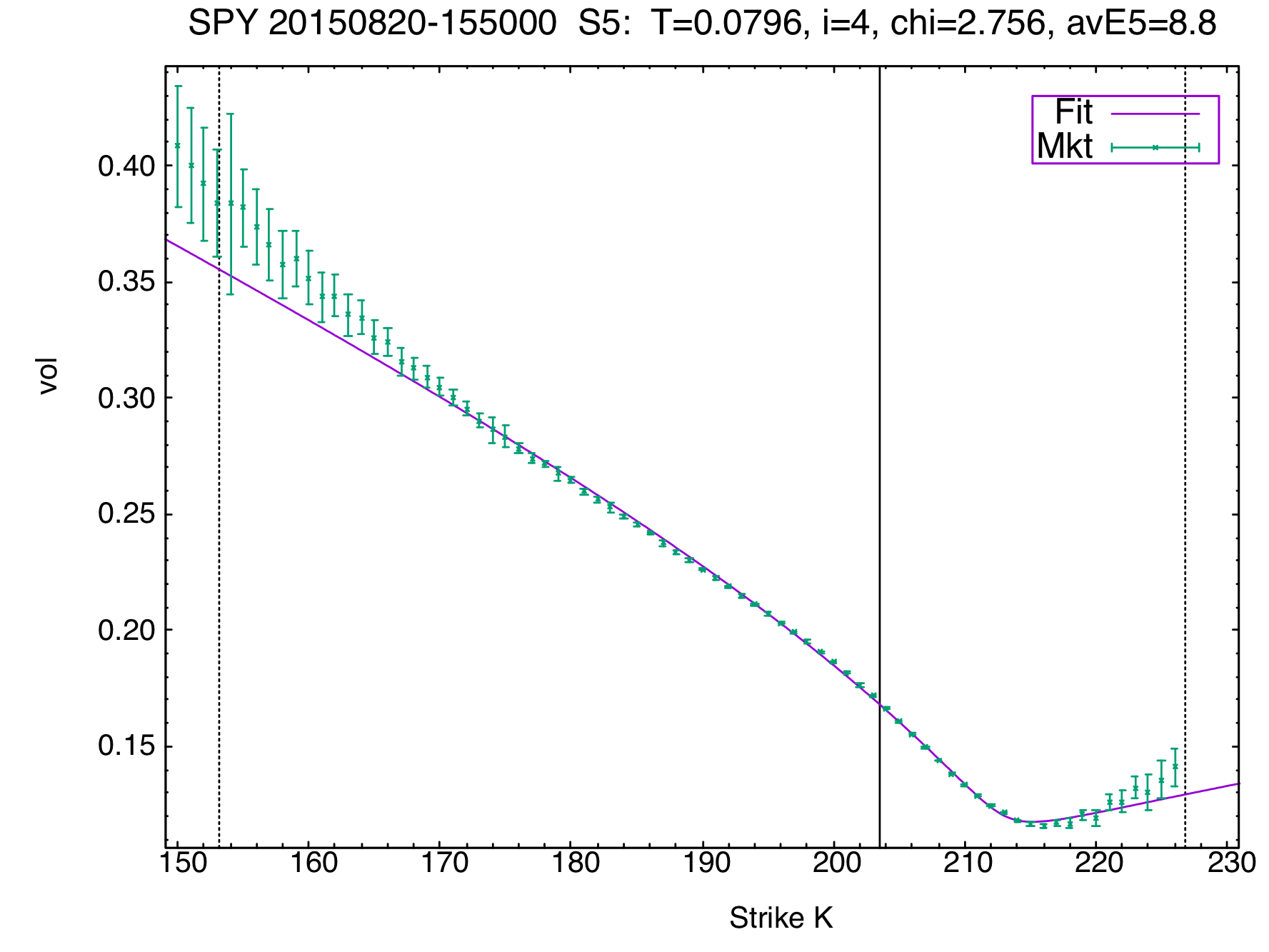
SPY August 2015 implied vol surface fitted with S5 (SVI) vs strike, second expiry — shows bias

C10m

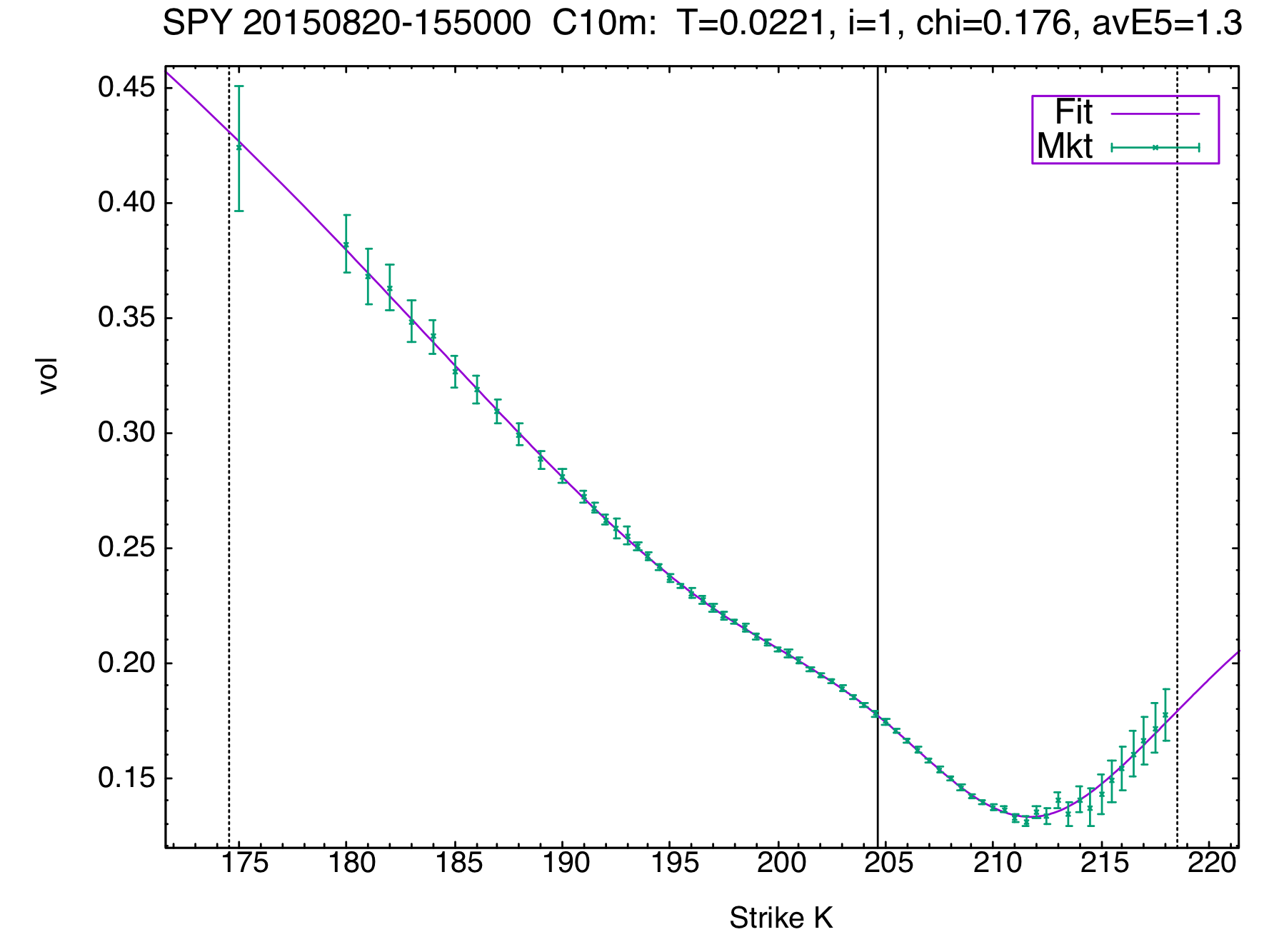
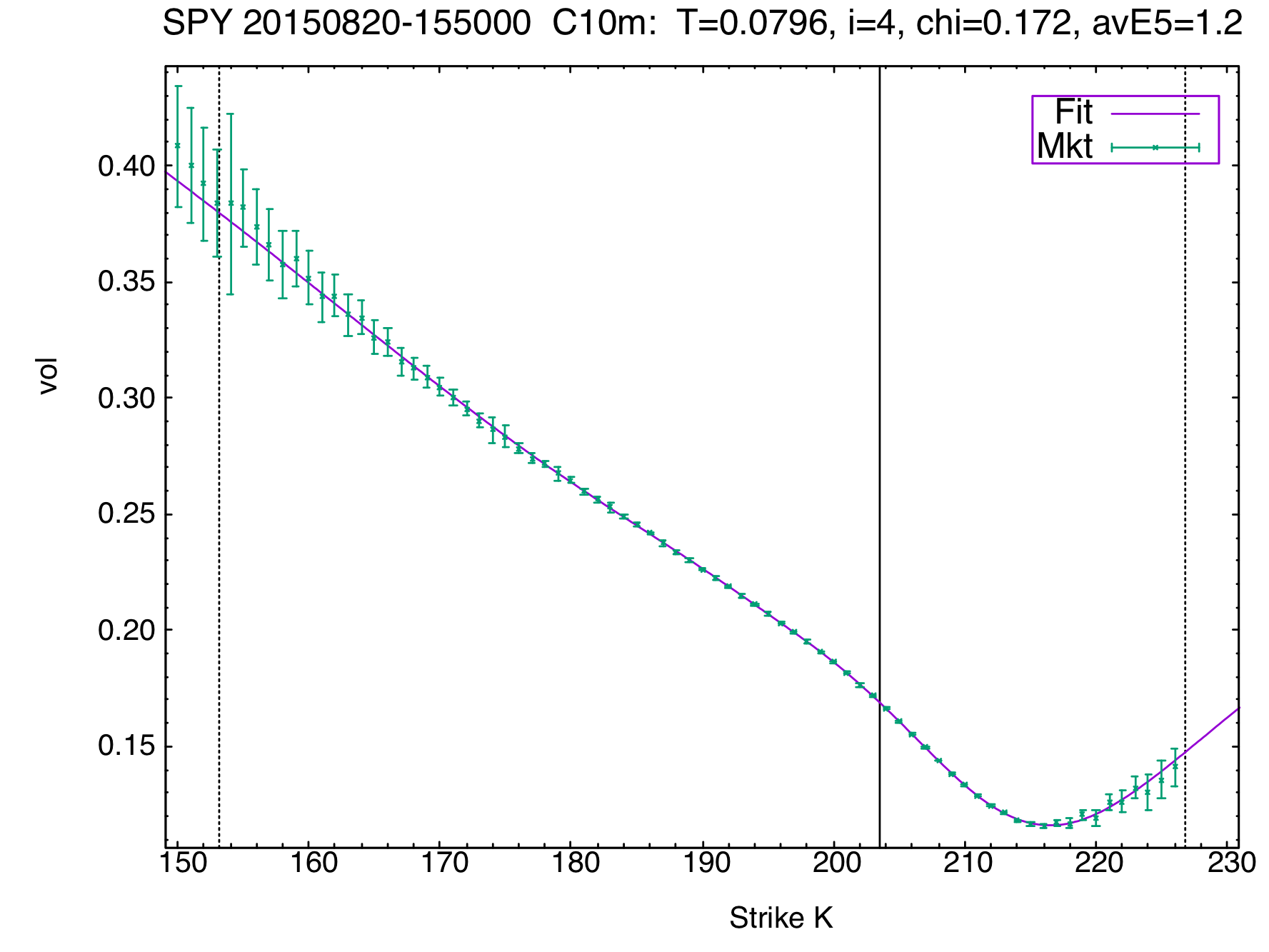
SPY August 2015 implied vol surface fitted with C10m vs strike, second expiry — no bias

S5

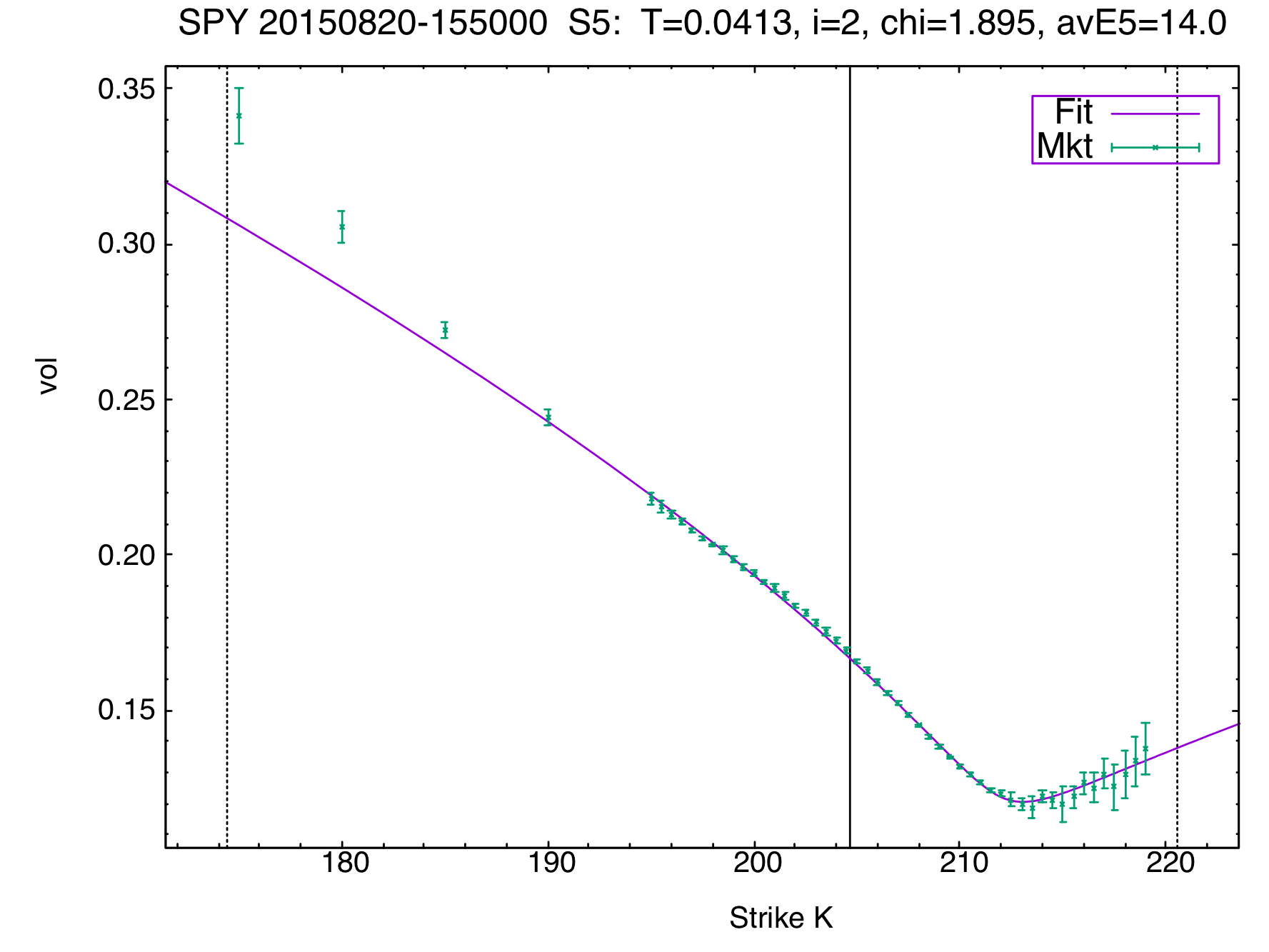
SPY August 2015 implied vol surface fitted with S5 (SVI) vs strike, third expiry — shows bias

C10m

SPY August 2015 implied vol surface fitted with C10m vs strike, third expiry — no bias

S5

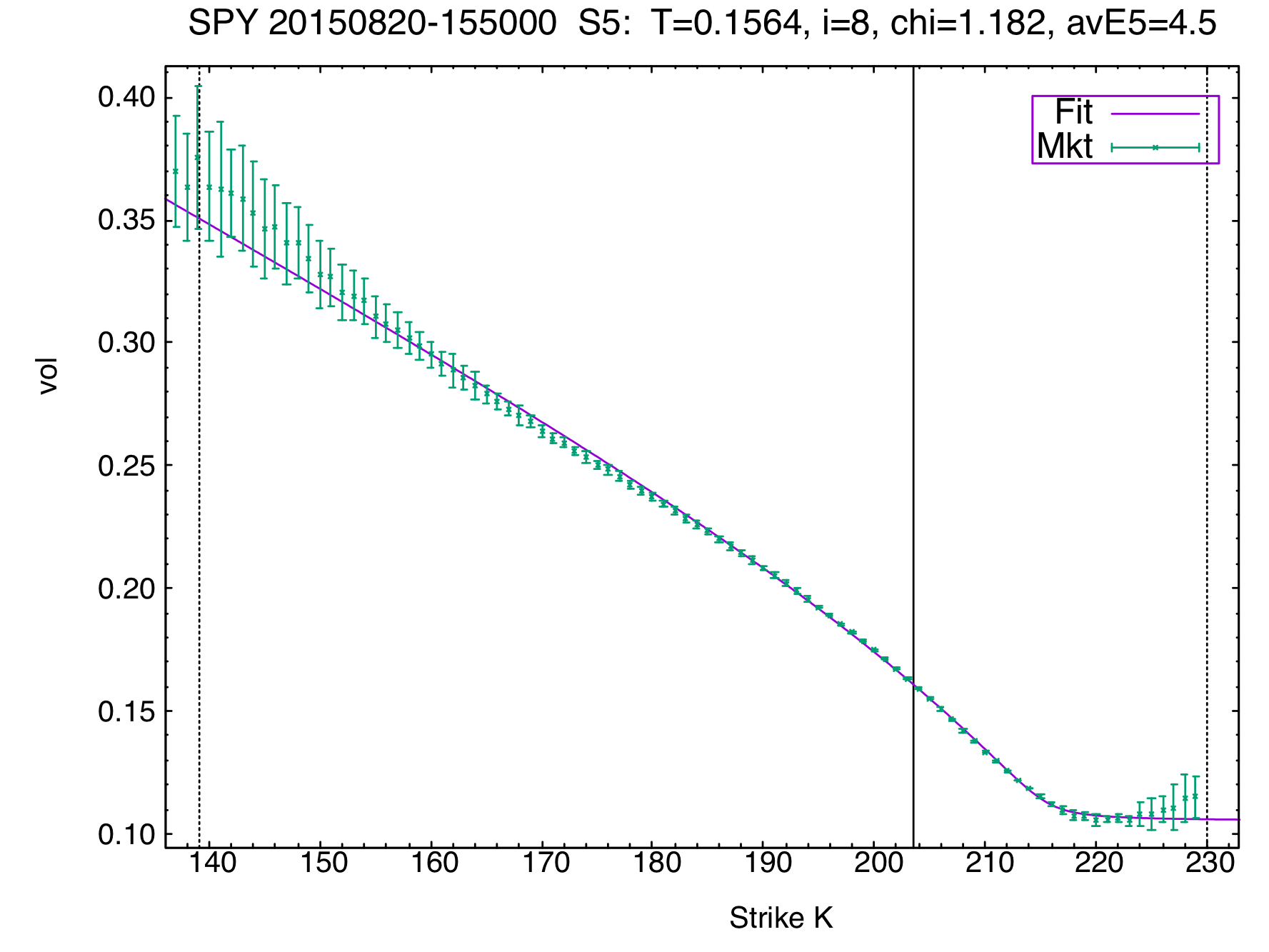
SPY August 2015 implied vol surface fitted with S5 (SVI) vs strike, fifth expiry — shows bias

C10m

SPY August 2015 implied vol surface fitted with C10m vs strike, fifth expiry — no bias

S5

SPY August 2015 implied vol surface fitted with S5 (SVI) vs strike, ninth expiry — shows bias

C10m

SPY August 2015 implied vol surface fitted with C10m vs strike, ninth expiry — no bias

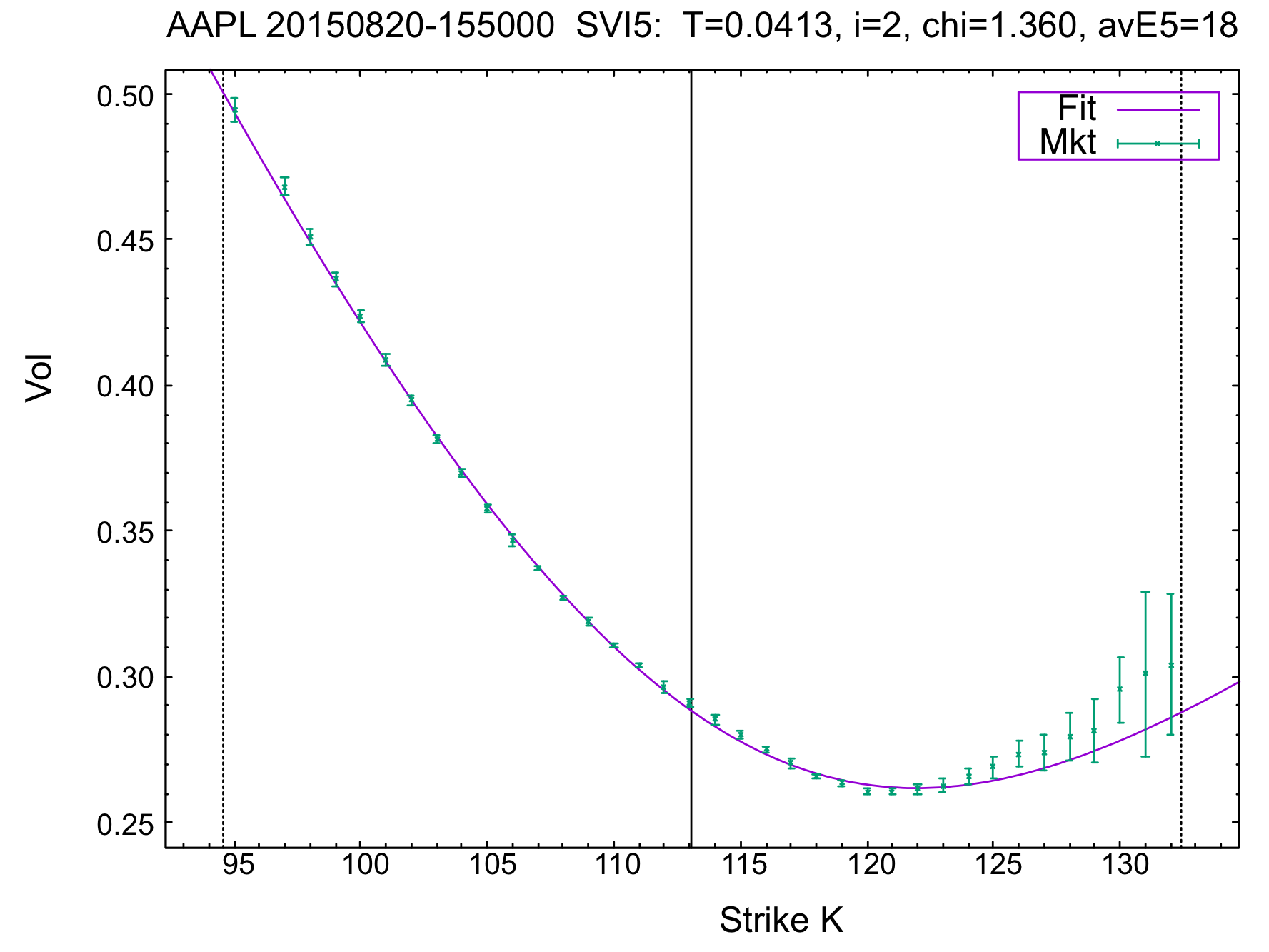
SVI5

AAPL August 2015 implied vol surface fitted with SVI5 vs strike, third expiry — shows bias

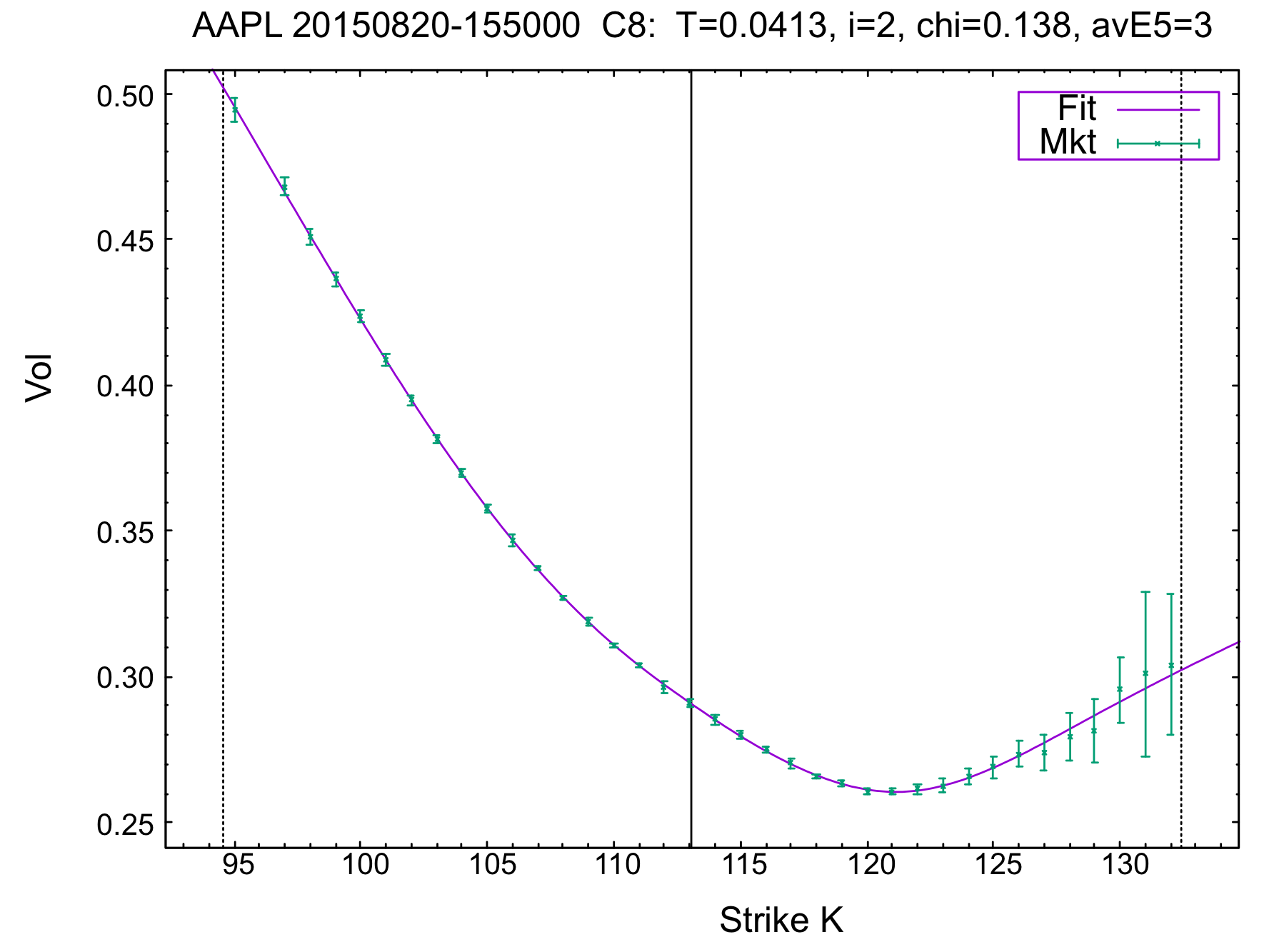
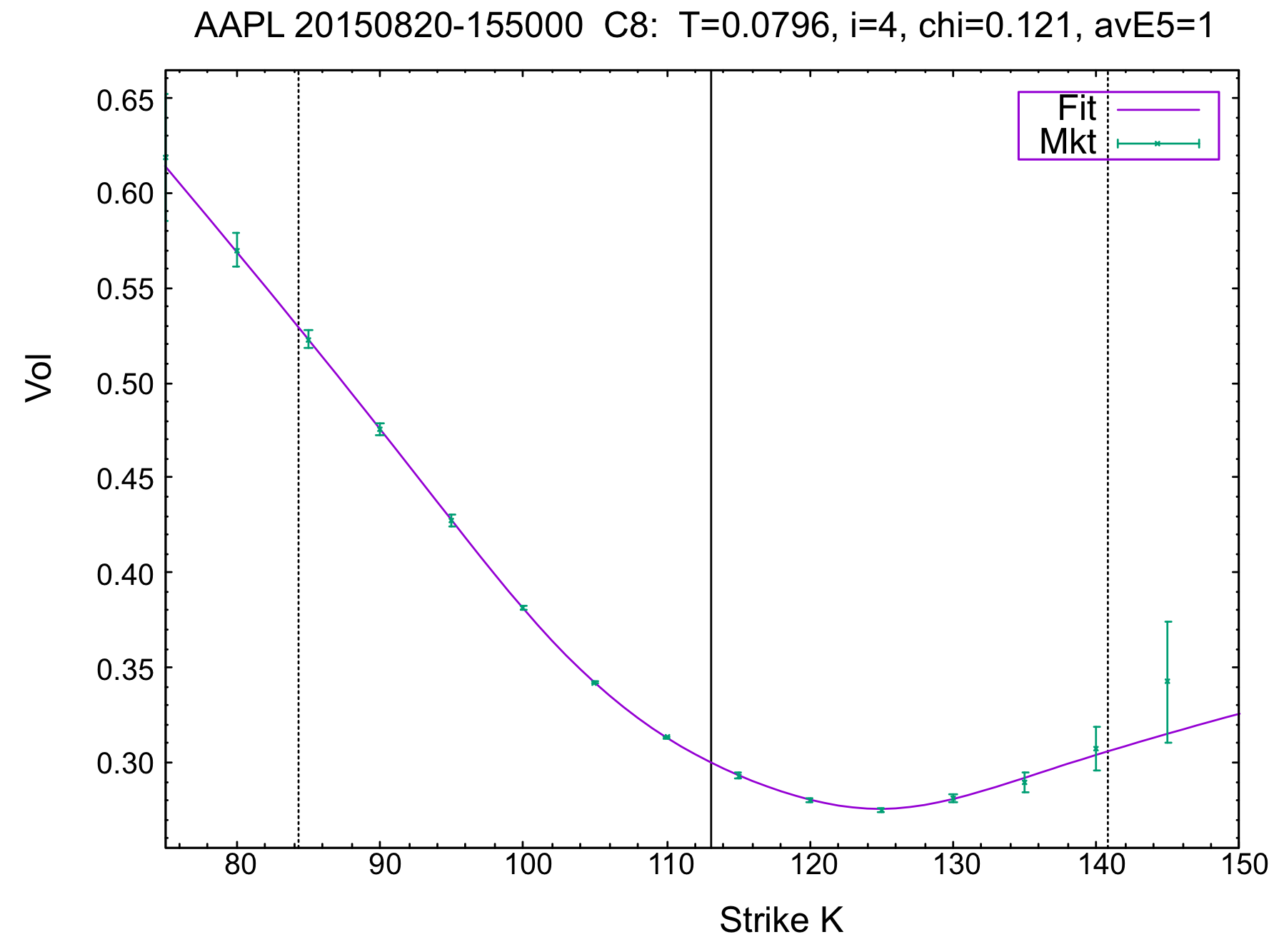
C8

AAPL August 2015 implied vol surface fitted with C8 vs strike, third expiry — no bias

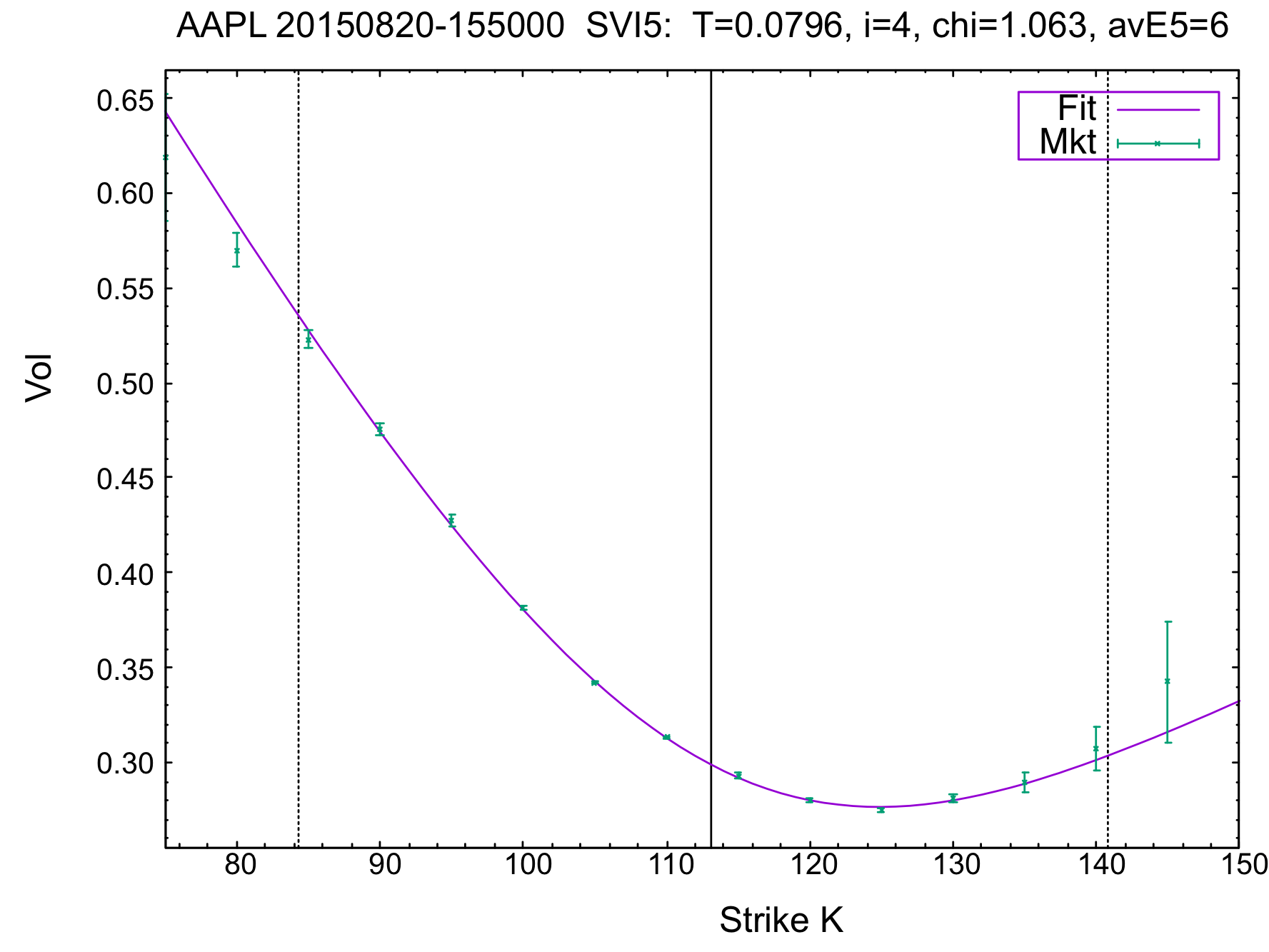
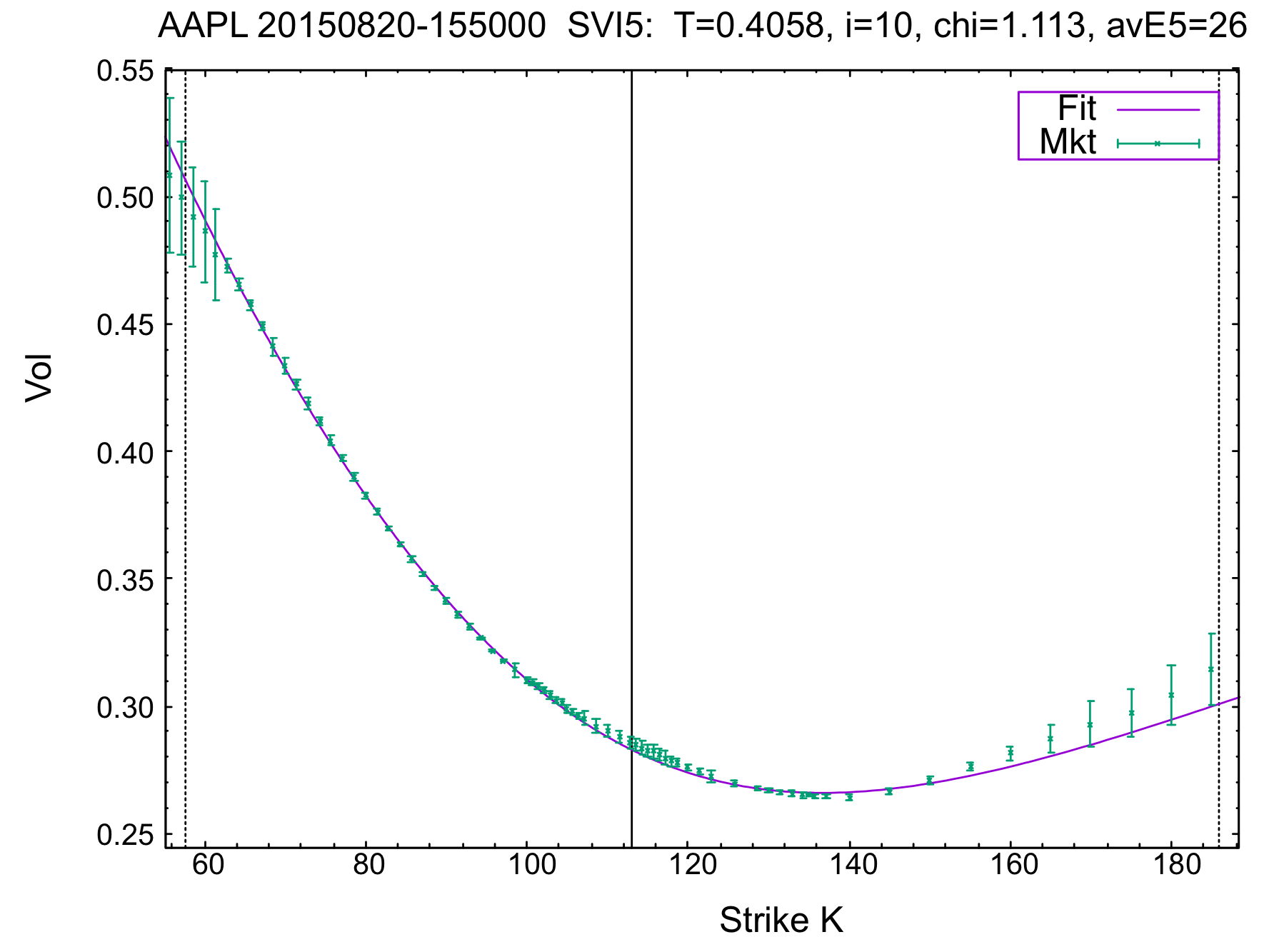
SVI5

AAPL August 2015 implied vol surface fitted with SVI5 vs strike, fifth expiry — shows bias

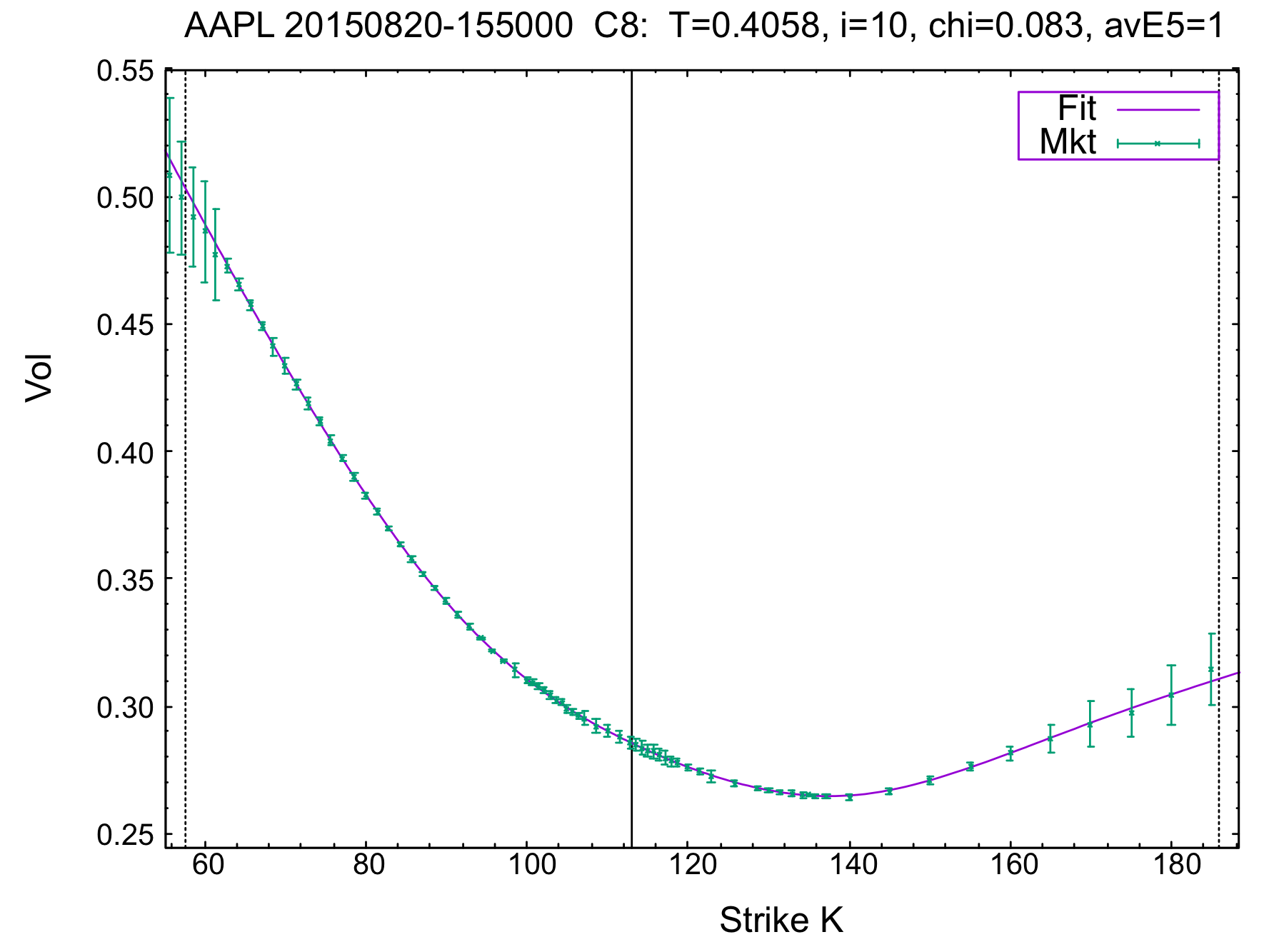
C8

AAPL August 2015 implied vol surface fitted with C8 vs strike, fifth expiry — no bias

SVI5

AAPL August 2015 implied vol surface fitted with SVI5 vs strike, eleventh expiry — shows bias

C8

AAPL August 2015 implied vol surface fitted with C8 vs strike, eleventh expiry — no bias

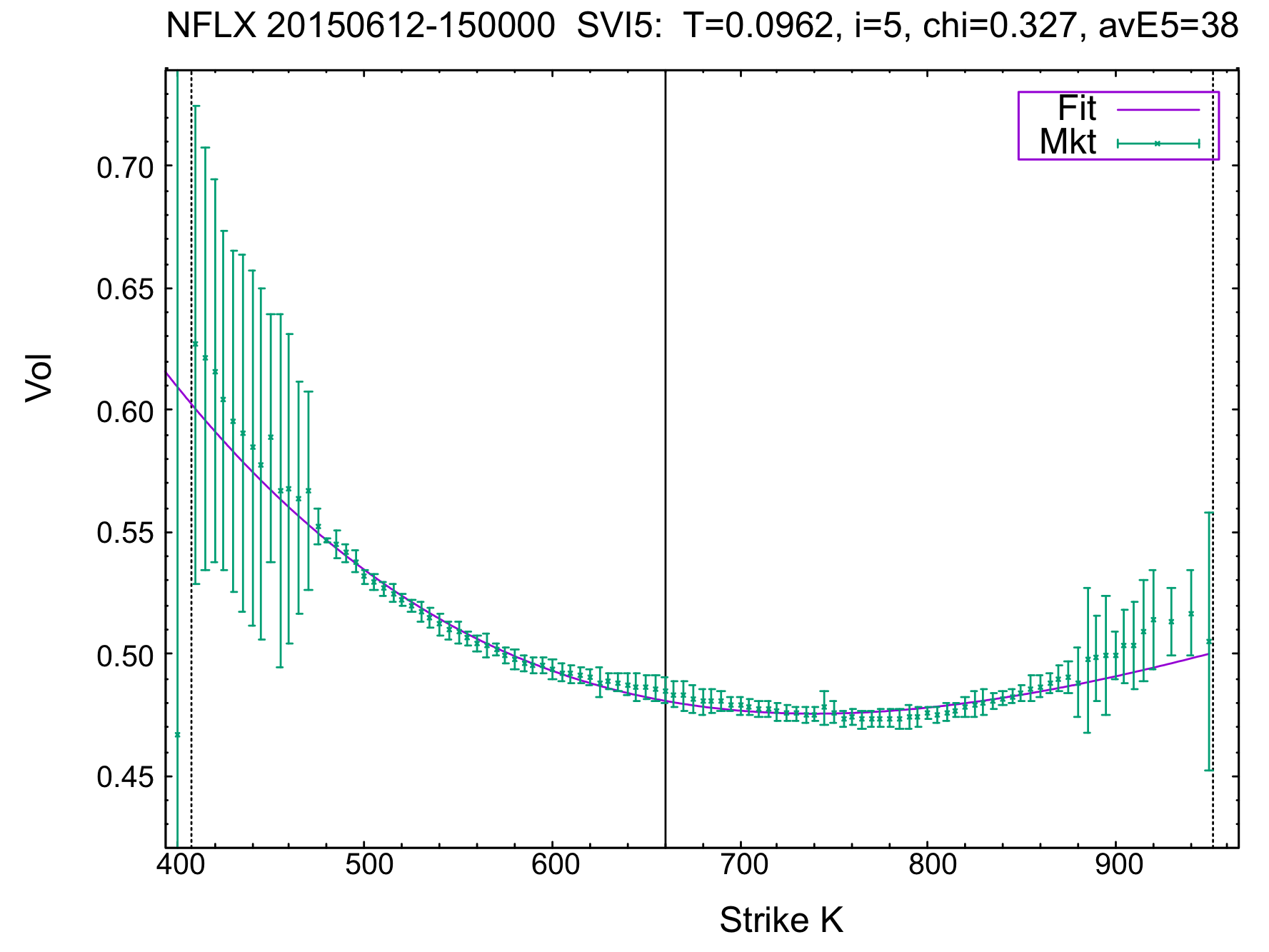
SVI5

NFLX June 2015 implied vol surface fitted with SVI5 vs strike — shows bias

C6

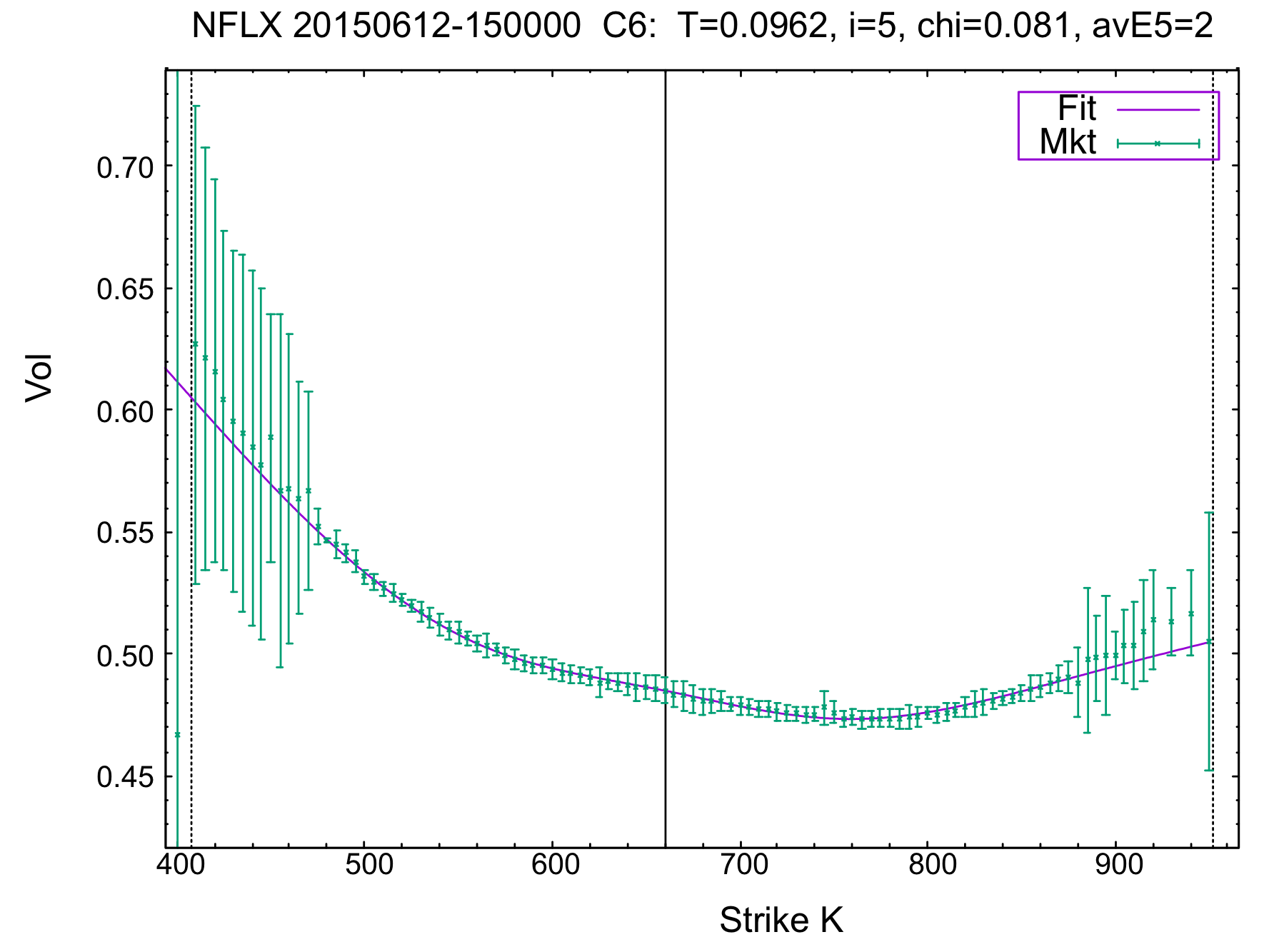
NFLX June 2015 implied vol surface fitted with C6 vs strike — no bias

SVI5

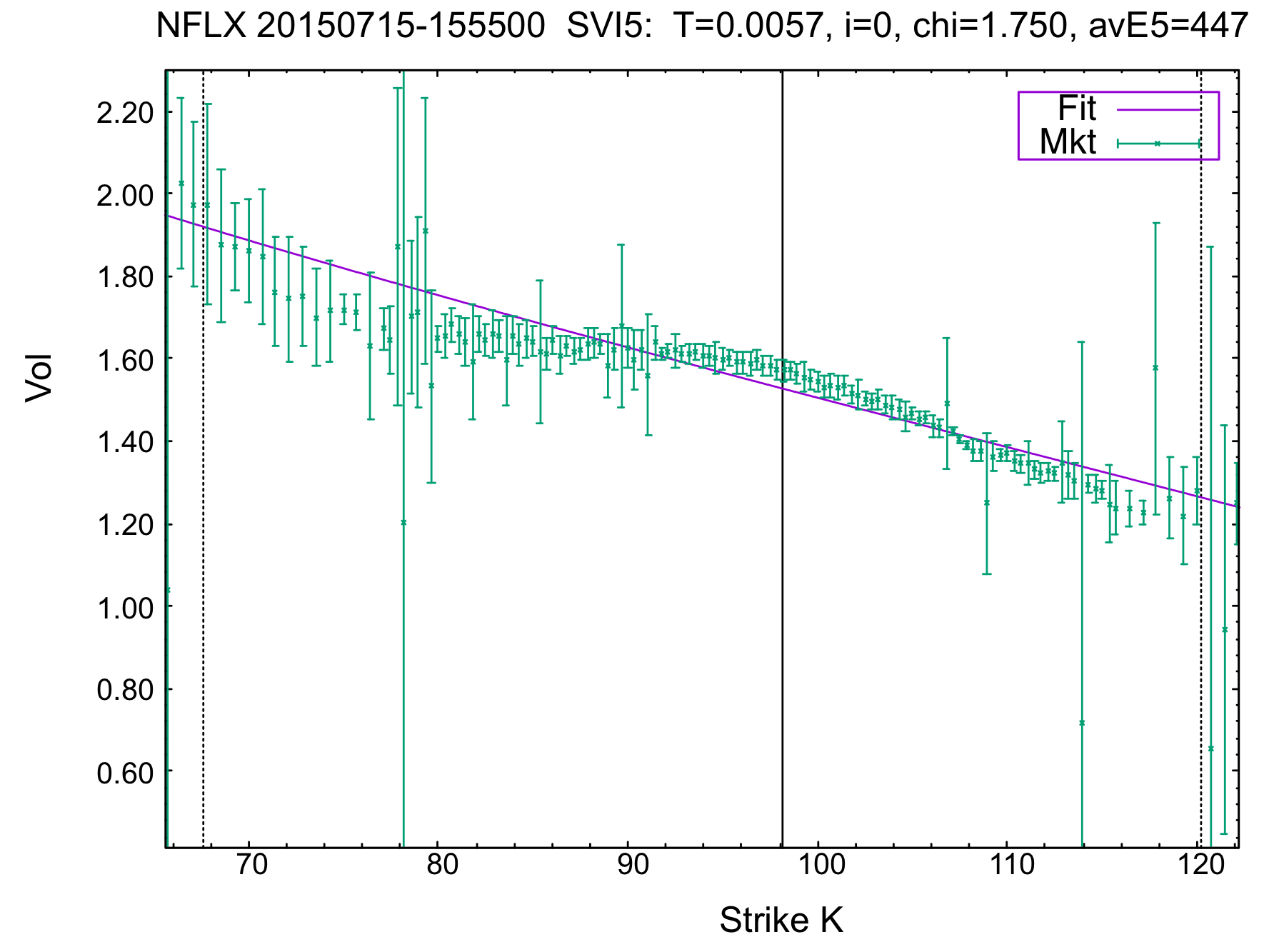
NFLX July 2015 implied vol surface fitted with SVI5 vs strike, near-term expiry — shows bias

C6

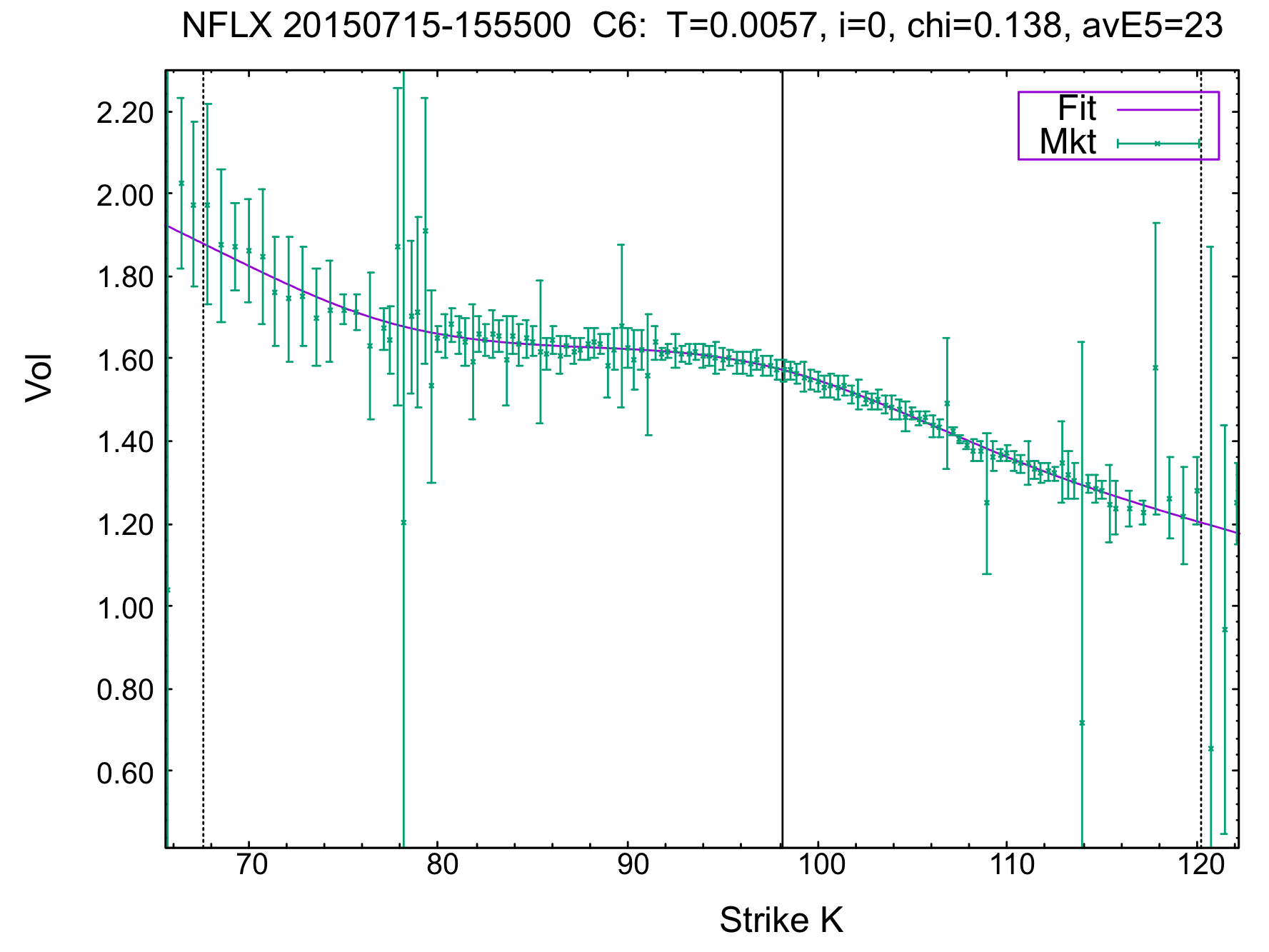
NFLX July 2015 implied vol surface fitted with C6 vs strike, near-term expiry — no bias

SVI5

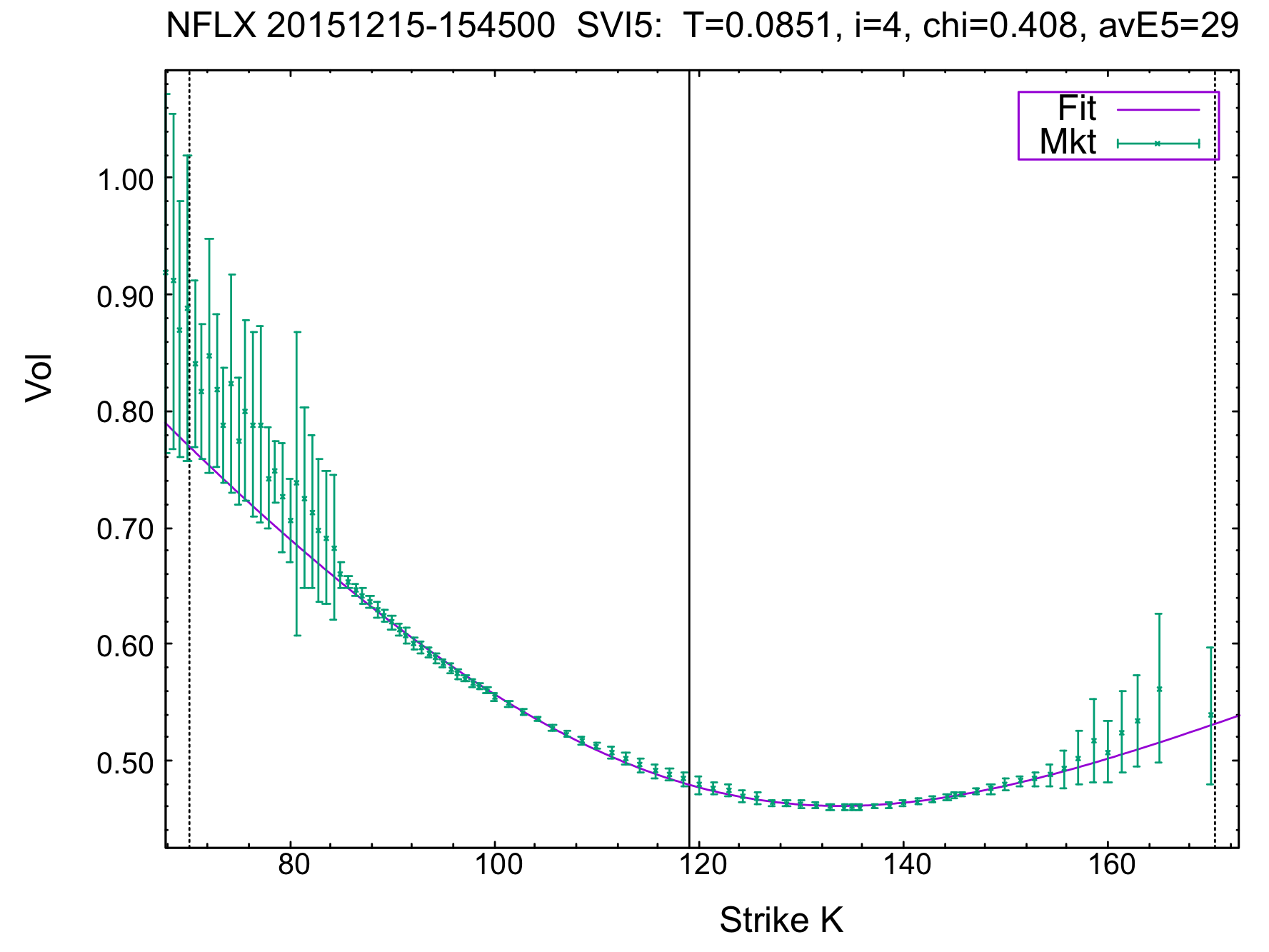
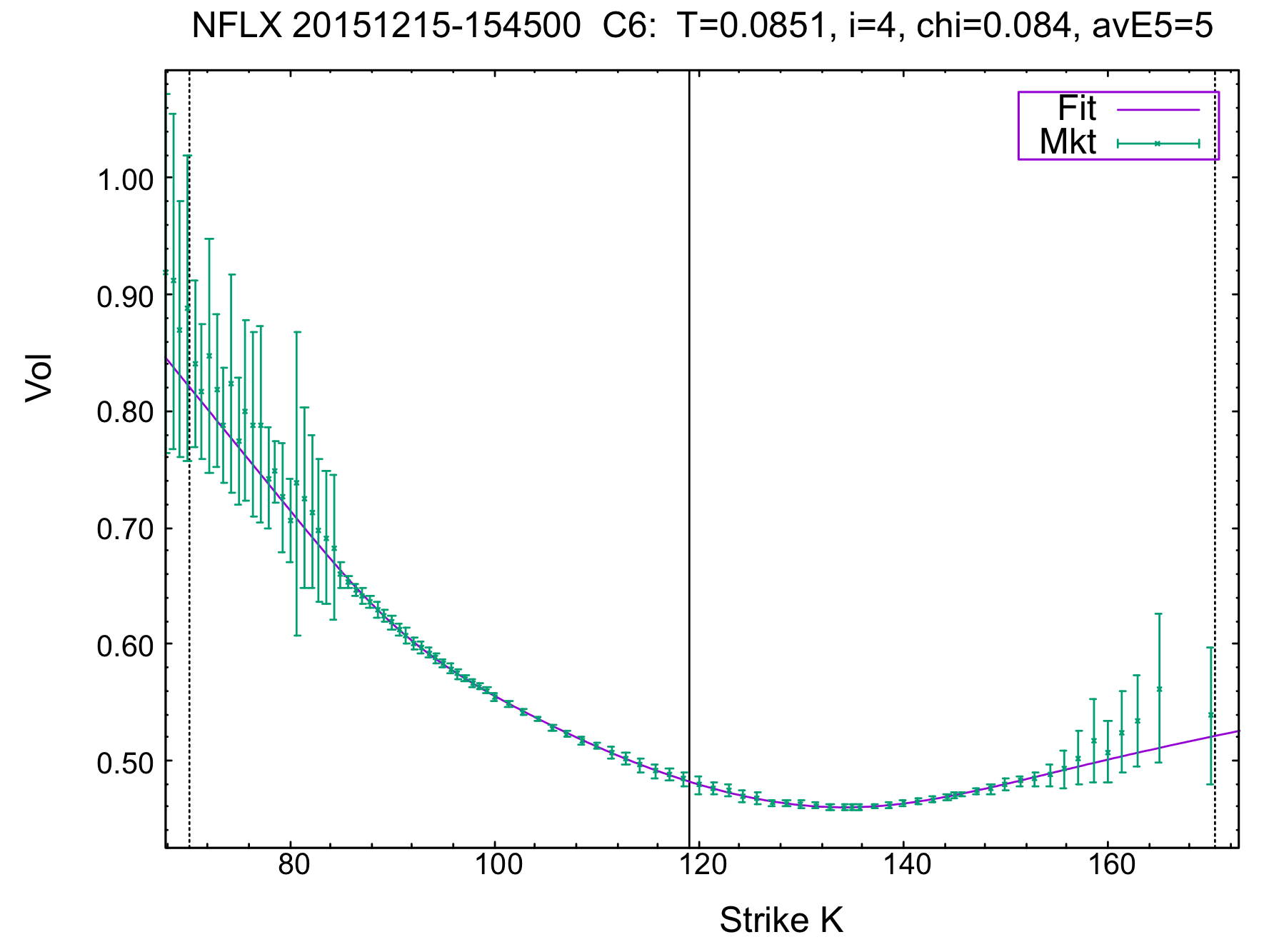
NFLX December 2015 implied vol surface fitted with SVI5 vs strike — shows bias

C6

NFLX December 2015 implied vol surface fitted with C6 vs strike — no bias

The best vol curve parametrization in the public domain is Jim Gatheral’s 5-parameter SVI curve. But, somewhat surprisingly perhaps, it does not allow one to fit some of the most liquid options in the world, like some in the SPX-VIX complex, or on tech names like AAPL, AMZN. Even qualitatively this is clear around events like FOMC for SPX, SPY, or earnings for technology names, since then the vol curve can have negative curvature around at-the-money, which is not allowed by the SVI curve1. But even away from such events, is it clear that something like our C* family of curves is needed to fit the options market on underliers like the above (and there are many other liquid names where SVI is not sufficient)2.

We should point out that this is not just a matter of the number of parameters the curve has (here 5 vs 6, 8, 10 or 12). Instead, it is related to the qualitative shapes allowed by the different curve types, which are too restrictive for SVI compared to what the market “wants”. As proof we note that even the 5-parameter version of our family of C* curves, C5, that allows more general shapes, will often fit liquid markets dramatically better than SVI.

Footnotes

  1. To be precise, we are here talking about the curvature of vol-squared versus log-strike (or normalized strike).

  2. It’s an interesting question why a perfectly sensible curve like SVI would not allow one to fit e.g. SPY options even away from FOMC days. Contact us to discuss!